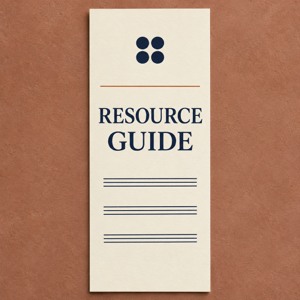
Start with the provider’s current resources and the items a family already uses. An ordinary branded product should fill a confirmed information gap, rather than replace an existing clinical or family resource. Before preparing materials, check what the visit message actually confirms.
For an office buyer, the useful review is about purpose and ownership: what already exists, who maintains or supplies it, and what is actually missing? A provider’s preparation page is not automatically a purchase order for the clinic.
AI illustration of reviewing ordinary materials. The coordinator, folders, inventory sheet and Resource Guide artwork are fictional. The bottle and bag are illustrative existing belongings, not clinical equipment or provider-approved supplies.
Keep the existing item’s purpose intact
Seattle Children’s occupational therapy visit page refers to existing adaptive equipment or pictures of it when relevant. Its speech and language visit page identifies familiar items for particular visit types and a current communication system for an AAC evaluation. These are specific provider examples of existing resources having a role.
They are not a general instruction to bring every listed item, replace a familiar item with a new branded version, or order one item for every family. The responsible team supplies the instructions for the actual visit. Leave decisions about clinical equipment, suitability and any substitute with that team.
Keep a family-supplied item separate from office stock in the materials plan. The person receiving a service, the family member supplying an item and the authorized buyer may be different people. Confirm the real owner before treating something as a clinic replenishment need.
Review the current information route as well as physical stock
Seattle Therapy’s Client Center already provides intake routes and a patient portal for records and forms. A new ordinary information card should help someone find an approved resource; it should not duplicate private records or create a second intake process.
Resource
Owner to confirm
Review decision
Provider instructions and reports
The responsible professional team and its established channel.
Use the current version; do not rewrite individual instructions as generic artwork.
Existing family item
The family and responsible provider for the actual visit.
Follow the specific confirmed instruction; do not assume replacement is needed.
Ordinary office materials
The stock owner and authorized buyer.
Check what is available and which nonclinical task remains unmet.
Public resource guide
The person maintaining the approved public page.
Confirm its purpose, contact route and update responsibility before printing.
Keep individual reports, device details and personal visit information in the provider’s established process. A public shopping brief needs the ordinary item’s purpose and approved artwork, not a copy of someone’s case file.
Worked example: close a materials review without a new pack order
Fictional example: an office is considering a new welcome pack with a generic bottle, bag and printed guide. It has not established that the pack solves a missing task. The coordinator completes this review first.
Provider resource: the maintained page and existing portal already carry the approved information. The information owner checks that the public contact route is current. Family item: any familiar or adaptive item remains subject to the actual provider’s instructions. The proposed logo bottle is not treated as a substitute. Office stock: ordinary folders are available for the office’s existing administrative use; the stock owner sees no confirmed gap requiring a new outer bag. Unresolved proposal: no owner has identified a useful job for the new welcome pack. Decision: keep the current resources and existing stock. Do not place the proposed pack order.
To finish, the coordinator records the information owner, stock owner and decision in the ordinary purchasing notes. A colleague can locate the current public page and tell which questions go back to the provider. If a new nonclinical need later appears, start a separate brief for that need rather than reopening the whole generic pack.
Consider paper only for an approved public resource
When reception has a confirmed need to share a stable public page, custom rack cards for an approved public resource guide are one possible ordinary paper format. The guide can name the resource and office contact while keeping individual preparation instructions in their original channel.
The linked SKU is 3.74 × 8.27 inches, with a default 14pt glossy option and a starting quantity of 50. A holder is separate. Check an actual-size proof and rack card formats and options when preparing approved artwork with DecentCustom.
The Resource Guide image is an AI design concept, not a clinical record, device label or therapy instruction. Keep the existing digital resource when another printed item would add no useful function.
Sources and linked SKU reviewed November 15, 2026. The completed review is fictional and concerns ordinary office purchasing. No individual preparation, equipment choice, cleaning method, therapeutic suitability or patient outcome is assessed.