A request to sit with a friend is a seating preference, not another admission. Build the workshop plan from confirmed places, then handle friend groups and waitlist offers separately.
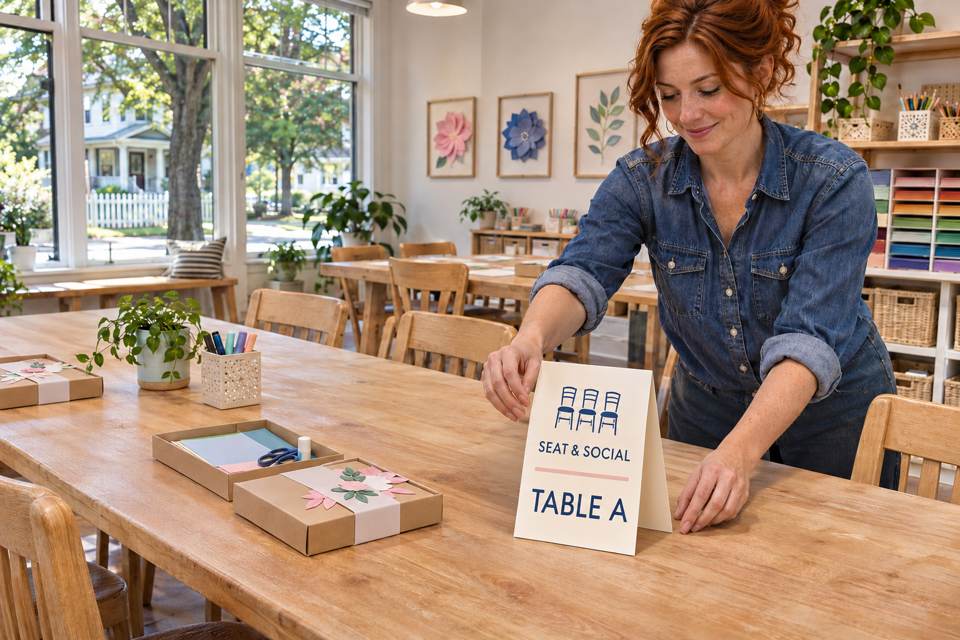
Keep admission, group preference and table location separate
For a small Galentine’s craft workshop, friends may buy places in different orders and then ask to sit together. That request is useful for planning, but it does not show that every named friend has booked. Record three different things: whether each place is confirmed, which confirmed participants want to sit together, and where the host plans to put them.
Check the ticket system before treating an apparent opening as a spare place. Eventbrite’s help article about available tickets and a waitlist explains that tickets can be tied to pending orders as well as completed registrations. It also warns that manually releasing waitlist tickets can exceed configured ticket quantities and total event capacity. A platform’s release option is not permission to fit another person into the room.
A second Eventbrite waitlist management article specifies that an entry corresponds to one ticket. A note saying “we are a pair” does not turn one entry into two admissions. These are examples of that platform’s documented mechanics, not instructions for every booking service or assigned-seat system.
A worked example: twelve approved places, ten confirmed
Seat & Social is a fictional studio. For this example, its host has already approved twelve usable participant workspaces for a paper project. Twelve is an input to the example, not a legal occupancy calculation or a recommended capacity for your room.
| Planning group | Confirmed places | Placement note |
|---|---|---|
| Group A | 2 | Two confirmed friends request the same table. |
| Group B | 3 | Three confirmed friends request the same table. |
| Participant C | 1 | No group request. |
| Group D | 4 | Four confirmed friends request the same table. |
| Separate waiting pair | Not confirmed | Wants two places together; kept outside the confirmed count. |
The confirmed count is 2 + 3 + 1 + 4 = 10 participant places. The difference from the host-approved twelve is 12 − 10 = 2. Before offering those places, the host still checks the current booking state, any pending orders and whether the actual arrangement supports the proposed group.
The studio’s illustrative placement record puts Group D at Table A, Group B and Participant C at Table B, and Group A at Table C. This accounts for ten confirmed participants. It does not promise that Table C’s remaining positions can be sold without another check; project materials, the actual layout and current bookings still matter.
Suppose the host decides it can offer only one additional place. The waiting pair must be told that this offer is for one person. If one person accepts and the booking becomes confirmed, the count becomes 10 + 1 = 11, leaving 12 − 11 = 1 unallocated example place. The uninvited friend is not silently added. If attending together is essential, the pair may decline and the host follows its stated offer process.
Update one booking change in the count and the placement record
When a place is confirmed, canceled or moved to another session, reconcile it against the booking record before changing the seating plan. A message asking to cancel and a completed cancellation are different states. Do not both keep the original participant in the count and add their replacement.
Give one host responsibility for the current version. The staff record needs enough information to match a confirmed booking and a group request; a public table marker does not. Use the letters A, B and C for wayfinding instead of printing a guest list, email addresses or payment status on the table.
Keep provisional placement clearly marked until the host has checked it. A general-admission workshop may be able to consider a group request without guaranteeing adjacent places. An event that sells specific assigned seats needs its own platform and venue process; a handwritten group note should not override those assignments.
Say exactly what the guest can rely on
For the fictional general-admission example, the booking-page note could read:
Coming with friends? Each participant needs a confirmed place. Send our host your group request after everyone has booked. We will review the request against the workshop layout; it does not reserve an extra admission or guarantee adjacent places. Check in with the host before choosing a table.
Use that note only if the real host actually accepts and reviews group requests. Confirm the correct contact route and wording before publishing. For the one-place offer in the worked example, the host’s message must make the limit explicit: “This offer is for one participant place. It does not include a second place for your friend.” This article sends no such message and makes no real offer.
The fictional staff handoff is equally short: “Use the current confirmed booking record first. Find the approved table letter in the placement record. If a guest brings an unconfirmed companion or requests a change, ask the host before promising a place.” That instruction gives the check-in person a next action instead of expecting them to improvise another seat.
Keep these admission questions consistent with the workshop invitation’s ticket-inclusion and collection details. A clear seating note cannot fix an invitation that still leaves the booking unit ambiguous.
A table letter helps people find a location; it is not a ticket
Existing numbered markers or a host’s verbal direction may be enough for a three-table event. A generic printed marker can help when the approved layout needs a visible table letter. Keep it independent of changing guest names, and test the letter’s readability from the real check-in position.
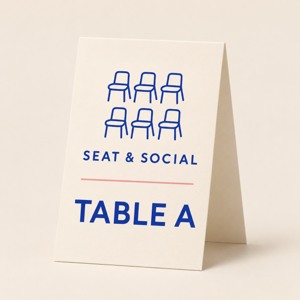
An optional freestanding paper marker
These custom table tents for simple workshop table letters are listed as 5 × 7 inches on 14pt card stock, with glossy as the default finish. The current quantity field specifies a minimum of 25. That can be more than a single three-table event needs; compare reusing existing markers before ordering.
Browse custom table tents for event wayfinding, then give DecentCustom the approved table-letter artwork and actual quantity requirement. A marker does not establish admission, room capacity or safe table placement.
AI table-tent concept and fictional counts. Official platform help and exact product fields reviewed November 16, 2026. No real tickets, attendee data or settings were accessed or changed; no guaranteed seating, availability or delivery is claimed.