A large discount headline cannot tell shoppers whether the blue notebook, its tan neighbor or the whole display qualifies. Set the exact offer first, then make the sign match the register.

Define the item before designing the discount headline
Start with the product identifier, variant and channel that the customer can actually buy. “Notebooks on sale” can suggest a wider offer than “blue A5 notebooks only.” A sign placed over mixed blue and tan stock can reinforce that wider impression, even if staff intended a narrower deal.
The FTC’s small-business advertising guide explains that price claims need support and that leaving out information can mislead. Treat the offer’s item limits as part of the message customers need before choosing, rather than a surprise at checkout. State and local requirements also matter; this practical example is not a legal review.
Fictional working case: True & Tidy wants to offer one blue A5 notebook at $15 before applicable tax. The adjacent tan A5 notebook remains $20 in this example. These are invented stationery-shop numbers, not prices for products linked below.
| Decision | Completed example brief |
|---|---|
| Eligible item | Blue A5 notebook, internal example code NB-A5-BL. Confirm the actual code in the real selling system. |
| Excluded neighbor | Tan A5 notebook NB-A5-TN; not included in this offer. |
| Offer price and channel | $15 each before applicable tax, in-store only; no code or membership required in this fictional arrangement. |
| Window | February 15, 2027, 10 AM–6 PM, at the fictional store’s local time. |
| Other offers | No additional coupons on this item during the example offer. A real retailer must approve and clearly communicate its actual rule. |
| Owner | The store manager approves the item list, copy and checkout test before the sign goes on display. |
Do not use the example’s hours unless they match the real shop. Coordinate the promotion with the Presidents’ Day store-hours guide, especially when a sale ends before the shop closes or a website uses a different time zone.
A correct percentage does not prove a genuine former price
If a supported comparison price were $20 and the offer price were $15, the saving would be $5: ($20 − $15) ÷ $20 × 100 = 25%. Use the comparison price as the denominator. Dividing $5 by the new $15 price would produce a different figure and would not express a 25% reduction from $20.
That calculation proves only the arithmetic. It does not establish that the shop genuinely offered this item at $20 in the relevant course of business. The FTC’s former-price comparison guide, 16 CFR 233.1 distinguishes a genuine regular former offer from an inflated reference price created to advertise a bargain. It also treats a claim about an actual former selling price differently from a mere asking price.
For this fictional brief, no real price history exists. Hold “was $20,” “save 25%” and similar comparison claims until the real retailer has reviewed supporting records and applicable requirements. The sample copy below states the item and current example price without inventing that history. Even a general sale claim still needs to be truthful; removing a crossed-out price is not a substitute for checking the offer.
Completed wording for the fictional current-price offer
True & Tidy — Presidents’ Day Offer
Blue A5 notebooks only — $15 each, before applicable tax.In-store February 15, 2027, 10 AM–6 PM local time.
Tan notebooks excluded. No code or membership required.
Cannot be combined with additional coupons on this item.
Replace every fictional term before use. Put the complete approved conditions where the shopper sees the offer. If space makes the conditions too small to read, shorten unnecessary decoration or choose a larger format. A large price plus unreadable restrictions is not a successful layout.
Test a mixed basket, not just the item in the headline
Before displaying the sign, scan one eligible blue notebook and one excluded tan notebook. The example subtotal should be $15 + $20 = $35 before applicable tax. A $30 subtotal suggests the reduction reached the excluded variant; a $40 subtotal suggests the eligible item did not receive the intended price. Investigate the actual rule rather than asking the cashier to remember an untested exception.
Also check the actual start and end behavior, the correct store or channel, and what happens if a customer presents another coupon. Use the selling system’s supported testing process; this guide does not change a register or require placing a paid order. If the sign, item list and approved checkout behavior disagree, keep the sign off display while the owner resolves the mismatch.
Place the notice beside the eligible stock, with excluded variants clearly separated. After the offer ends, remove its dated signs and check that the public website is no longer promising the expired price. Assign this to a named staff role rather than assuming the next shift will notice.
A small shelf card works only when the full offer remains readable
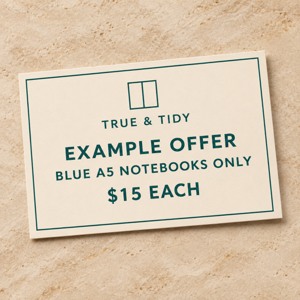
The illustration is a simplified front-side concept, not print-ready complete offer artwork. DecentCustom’s custom postcards for a checked shelf offer include a 6 × 4 inch landscape option. The product page lists 16pt as the default paper stock, a glossy-front default finish and purchase increments of 50.
A flat postcard needs a suitable existing display arrangement; a stand is not implied. Review custom postcards in other layouts and sizes if the approved conditions need more room. Send the actual item limits, dates and copy with the artwork requirements to DecentCustom; confirm the selected configuration before ordering.
If an existing shelf ticket already explains the offer accurately, keep it. A new print order cannot supply missing price-history evidence or correct a register rule.
Questions to settle before the sign goes up
Can “selected items” replace an item list?
It may still leave the shopper guessing. Identify the participating item or clearly marked group where the offer appears, and test that the selling system uses the same selection.
Should the card show 25% off or $15 each?
Choose only a claim the real retailer can support. The worked percentage is conditional arithmetic; the fictional example does not establish a real former price. Either presentation still needs the material item and offer conditions.
Does a correct sign guarantee correct checkout?
No. The mixed-basket test checks a different part of the purchase. Approve both the customer-facing message and actual selling behavior before starting the promotion.