“Needed for Presidents’ Day” is a use date, not a production schedule. A useful order brief tells the supplier when the artwork will be approved, where the goods must arrive and who will inspect them.

Approval, shipment and arrival are different events
For a custom tote order, a payment receipt confirms a transaction. An artwork file confirms that a file was sent. A proof approval records a particular version accepted for production. None of those, by itself, confirms that the finished bags have reached the shop.
The FTC’s order-merchandise business guide defines shipment as physical placement with the carrier. Keep that separate from a requested arrival date. A tracking number or printed shipping label alone does not establish physical handoff or receipt.
The same guide describes a properly completed order in terms of payment and the information needed to fulfill it. Ask what the supplier’s quoted production estimate includes, but do not treat artwork approval as an automatic reset of shipping obligations. This planning guide does not decide the legal status of a particular order.
Record the exact approved artwork version, item, color, quantity and delivery address alongside the timing reply. Otherwise a perfectly clear date can be attached to the wrong product or an outdated logo.
A completed brief labels requests as requests
Ready & Route is a fictional independent shop. It wants 24 small blue totes ready before its Monday, February 15, 2027 use date. The dates below are invented planning targets, not supplier estimates. The shop must obtain a feasible written schedule before relying on any vendor-dependent step.
| Checkpoint | Example target | What still needs confirmation |
|---|---|---|
| Send a complete request | Monday, January 25 | Exact blue tote, 24 units, artwork, delivery address and receiving contact. |
| Buyer artwork decision | Thursday, January 28 | The named buyer approves the actual proof version; merely receiving a proof is not approval. |
| Production completion | Monday, February 1 | Supplier must confirm feasibility for the actual item and order; this date is currently unconfirmed. |
| Carrier handoff | Tuesday, February 2 | Supplier’s dispatch commitment and actual carrier acceptance, separate from label creation. |
| Arrival at the shop | Tuesday, February 9 | Requested receipt date at the actual address, not an assumed result of the dispatch target. |
| Receipt inspection | Wednesday, February 10 | Shop staff compare received quantity, color and printed artwork with the approved order. |
| Store setup | Friday, February 12 | Use only items that have actually arrived and passed the shop’s check. |
These are calendar dates checked for the stated year. They are not a calculation of a carrier’s business days, an advertised production time or a guarantee that enough recovery time exists. Replace every target using the actual supplier reply, route, receiving arrangements and staff availability. A federal holiday date does not establish a carrier’s collection or delivery service.
The use date also does not prove that the bag suits the intended contents. Complete any necessary packing trial separately; the boxed-bundle bag-fit guide explains why nominal width and height alone cannot settle that question.
Ask for dispatch and arrival information separately
We are considering 24 blue small cotton totes for use on February 15, 2027, with shop setup on February 12. Our requested arrival at the confirmed delivery address is February 9. We plan to review the artwork proof by January 28.
Please confirm whether this schedule is feasible for the exact item, quantity and decoration. Identify the estimated production completion, expected carrier handoff and available delivery timing separately. State what information or approvals remain outstanding, what each estimate depends on and what changes would require a new timing review.
This is draft request wording, not a message already sent or an accepted schedule. If the reply gives only “ships in X days,” ask which event starts that estimate, which days count, whether production is included and what delivery information applies to the actual destination. Do not silently turn a dispatch estimate into a guaranteed arrival date.
The FTC’s rule summary explains that sellers need a reasonable basis for advertised shipment timing and addresses consent to shipping delays or refunds for unshipped goods. Its general 30-day provision is not a promise that a custom order will arrive before your event. Check the actual order terms and applicable requirements rather than using that number as a planning shortcut.
A late logo revision needs a fresh feasibility check
Suppose the buyer changes the logo after the example January 28 artwork target. Record the new proof version and ask whether the previously discussed production, handoff and arrival information still applies. Do not keep advertising the old date simply because it remains in a spreadsheet.
If the custom schedule cannot be confirmed, consider using existing approved packaging for the holiday. Agree any product or color substitution explicitly before accepting it; a different bag can change the artwork, packing suitability and sourcing requirements. A rush label is not evidence that a feasible replacement plan exists.
On receipt, compare the actual bags with the approved brief and retain a clear record of discrepancies. A delivery scan answers where the parcel went; the shop’s count and artwork check answer whether it received what it approved.
Verify the chosen tote before attaching dates to it
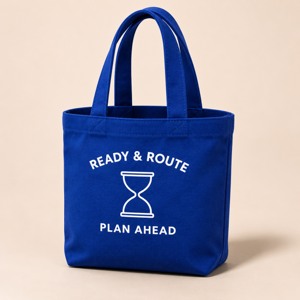
The illustrated candidate is the small custom cotton tote, listed at 8.75 inches wide by 8.25 inches high with an open main compartment and matching handles. The current page includes a blue option and a quantity minimum of 12; its 100-piece case pack is a separate specification.
These fields do not verify stock reserved for an order, usable depth, a production slot or delivery timing. Compare custom cotton bags in other sizes and styles if the task calls for another format, and give DecentCustom the actual artwork, quantity, destination and required dates for an order-specific review.
The blue Ready & Route design is an AI concept. It is not a photographed production sample, a load test or a promise of the example schedule.