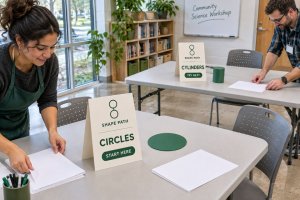
A Pi Day station works better when its task is clear. Start with circumference, offer a cylinder-volume extension and keep worked answers nearby so the facilitator can respond to a specific misunderstanding.
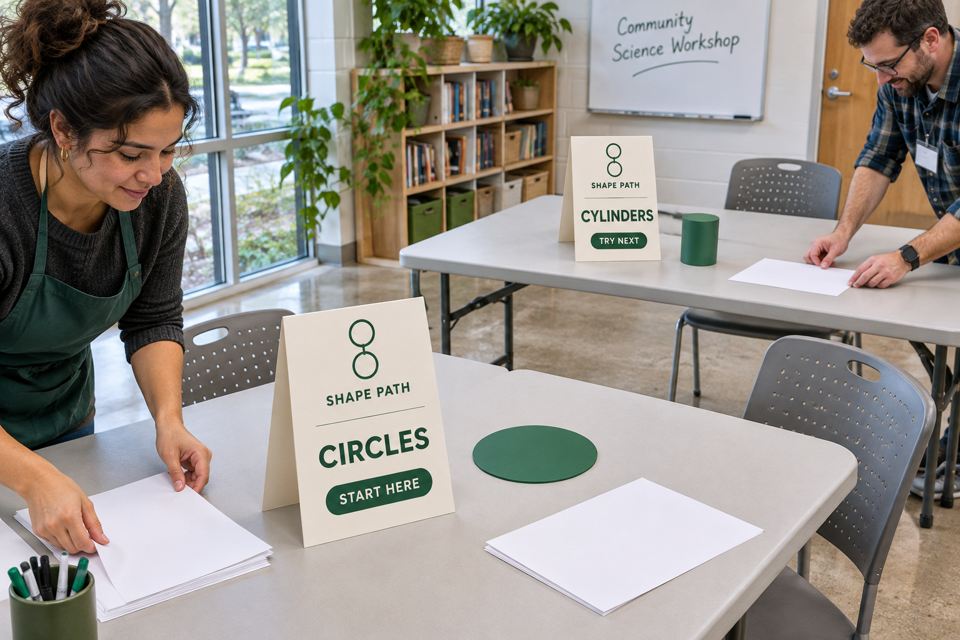
Choose a Pi Day activity by what participants can already use
Match the task to the required math before choosing the printed materials. A circumference question and a cylinder-volume question both use pi, but the second adds radius, squaring, height and cubic units. Sharing the same theme does not make their prerequisites identical.
For example, NASA JPL’s Tubular Tally lesson uses cylinder volume in a Mars rock-core context and lists grades 8–12. That range describes the source lesson. It does not establish that every Pi Day activity suits every age or that the original problem is the right starting point for your group.
Shape Path is a fictional community workshop plan. Its facilitator offers two routes and lets participants begin where they are comfortable. Before starting, ask someone to point out a circle’s diameter, explain how radius relates to it and describe the unit expected for a length. For the extension, check familiarity with squaring and volume. These are conversation prompts, not a standardized placement test.
The two exercises below are independently written examples with invented ideal shapes and exact inputs. They do not reproduce NASA’s worksheet or describe real Mars samples. They can be written on existing paper; custom signs are optional.
In the fictional setup, the host provides paper and pencils at both stations and a shared calculator where needed. Borrowed demonstration objects keep their existing ownership labels, with a marked return tray for the end of the session. Tell participants which materials are supplied and where shared items go back. A printed station name does not replace those instructions or justify replacing a useful existing kit.
Station 1: find the distance around a circle
Circles · Start here
An ideal circle has a diameter of 10 cm. Use π ≈ 3.1416 to calculate its circumference. Write the formula, substitution and unit. Then explain what would happen to the circumference if the diameter doubled.
Worked answer: C = π × D = 3.1416 × 10 = 31.416 cm. If the diameter becomes 20 cm, the calculated circumference becomes 62.832 cm. Doubling D doubles C because the formula multiplies the diameter by the same constant.
Ask the participant to explain why the answer uses centimeters. The task asks for a distance around the circle. It is not an area, so cm² is not the appropriate unit. If the participant instead uses 5 cm, ask whether that number is the radius and return to the stated diameter.
This is a calculation from a given diameter, rather than a physical measurement activity. If participants want to investigate real objects, use the circumference-and-diameter measurement notes example to keep the readings and possible measurement problems visible.
Station 2: add radius, height and cubic units
Cylinders · Try next
An ideal solid cylinder has a diameter of 4 cm and a height of 5 cm. Use π ≈ 3.1416 to calculate its volume. Show how you obtain the radius and explain the unit in your final answer.
Worked answer: r = D ÷ 2 = 4 ÷ 2 = 2 cm. Then V = π × r² × h = 3.1416 × 2² × 5 = 3.1416 × 4 × 5 = 62.832 cm³.
The squared radius supplies cm², and multiplying by height in cm gives cm³. The answer describes volume in this ideal-shape exercise. It is not a measured container capacity, usable packaging space or a product performance claim.
A participant who can calculate circumference may still need support with this extension. Offer a sketch showing the radius from the center to the edge and label the height separately. Let them continue the first task, discuss the setup with a facilitator or try the extension with a partner. Do not turn the second station into a compulsory speed contest.
Use the working to decide what to explain next
If the cylinder answer is 251.328 cm³: check whether 4 cm was substituted as the radius. That gives 3.1416 × 4² × 5, four times the correct example volume. Ask the participant to mark the center and halve the stated diameter, then repeat the substitution with 2 cm.
If the arithmetic is right but the unit is cm: ask what the calculation represents. For circumference, a length unit fits. For the cylinder exercise, the multiplication includes three length factors and produces cubic units. Keep the reasoning tied to the specific formula rather than asking for a memorized unit in isolation.
If someone gets an unexpected numerical result: first check the chosen formula, radius and units before discussing additional pi digits. Both exercises specify the approximation to use. The worked pi-rounding comparison addresses a different question: choosing precision for a stated calculation limit.
For a useful closing prompt, ask the participant to compare the two tasks: “What extra information and operations did the cylinder need?” An answer can name the radius, height, squaring and the change from a length to a volume. Record any actual observations honestly; this planning example is not evidence of learning improvement.
Keep the original prompts and worked answers with the facilitator. A station label can help someone find the task, but “Circles” alone does not tell them which value to calculate. Put the full prompt where it can be read, and make an explanation available without requiring a purchase or a particular device.
Printed tents can identify stations; existing labels may be enough
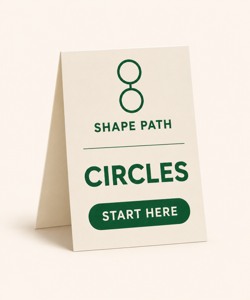
For two temporary stations, existing folded paper labels may be sufficient. If a recurring program needs custom navigation, the linked custom paper table tents for activity-station labels list a 5 × 7 inch format, 14pt paper and a default glossy finish. The current minimum quantity is 25, which may exceed a small session’s needs.
The fictional Shape Path artwork shows a “Circles · Start here” face and a separate “Cylinders · Try next” concept in the scene. Confirm the actual artwork versions and selected configuration with DecentCustom. Compare custom table tents for other indoor display needs when appropriate. These paper signs do not include a tested lesson, a plastic stand or a guarantee of learning results.