Choose pi’s precision for the calculation you need. A worked circumference example shows when 3.14 misses an illustrative limit and 3.1416 meets it, while keeping calculation error separate from real measurements.

How many digits of pi do you need?
Use enough digits to meet the calculation’s stated requirements; there is no single number of digits for every task. Follow a problem’s specified approximation when it has one. Otherwise, keeping the calculator’s pi value through the calculation and rounding the final answer avoids unnecessary intermediate rounding.
NASA JPL’s answer to a reader’s question about pi decimals gives 3.141592653589793 for its highest-accuracy interplanetary navigation calculations. That number has 15 decimal places. The example does not establish a requirement that every workshop use 15 places or that 3.14 is sufficient for every calculation.
Curve Lab is a fictional community learning session. Its discussion goal is to explain why the chosen approximation matters for a stated numerical limit. Memorizing more digits is a different activity. Neither a long recitation nor a printed formula establishes that a person can choose an appropriate approximation.
Worked example: a 200 mm circle and a chosen error limit
This is an invented calculation exercise. Assume the diameter is exactly 200 millimeters and compare two approximations using C = π × D. Choose an illustrative limit of less than 0.1 mm difference in the calculated circumference. This limit is a teaching assumption, not a product tolerance, machining instruction or measurement capability.
Using 3.141592653589793 as a finite reference gives a circumference of 628.3185307179586 mm. That reference itself is not exact pi; its precision is sufficient for the differences shown here.
| Pi value | C (mm) | Difference (mm) | Below 0.1 mm? |
|---|---|---|---|
| 3.14 | 628 | 0.31853 | No |
| 3.1416 | 628.32 | 0.00147 | Yes |
The comparison uses absolute difference = |chosen pi value − reference value| × diameter. For 3.14, the difference is approximately 0.31853 mm, which exceeds the chosen 0.1 mm limit. For 3.1416, it is approximately 0.00147 mm, which is below that limit. The table’s displayed differences are rounded to five decimal places.
That result supports a limited conclusion: 3.1416 meets this exercise’s approximation-error limit under the exact-input assumption; 3.14 does not. It does not mean that every physical circle of this nominal size can be measured, made or printed to that accuracy.
The size and requirement both matter. If the same diameter were 20 mm instead of 200 mm, each approximation difference would be one-tenth as large. If a new problem sets a different limit, repeat the comparison. Do not treat “four decimal places passed once” as a universal rule.
More pi digits do not repair uncertain inputs
A calculation can display many decimals while its input is only a rough reading. If a participant writes “about 200 mm” after using an ordinary ruler, the exact-input assumption in the worked exercise no longer describes that measurement. You need information about the actual reading, object and measuring method before claiming a physical accuracy.
Keep two questions separate: “How much difference did approximating pi introduce?” and “How well do we know the diameter and the shape?” Adding digits addresses the first question. It does not make an off-center line into a diameter or turn an uneven object into an ideal circle.
The Pi Day circumference-and-diameter measurement example shows how to keep original readings and investigate a unit, radius or rim mix-up. Use that kind of record when moving from an assumed number to a real object. Do not insert the worked table’s invented values into a participant’s observation sheet.
For printed educational artwork, keep notation accurate too: π ≈ 3.14 says “approximately.” Writing π = 3.14 asserts exact equality and changes the mathematical statement. A decorative shirt or card should support the explanation without teaching that error.
Ask for the reason, then check the answer
Give a learner the 200 mm exercise and ask: “Would 3.14 meet the stated limit, and what changes if we use 3.1416?” A complete answer identifies the limit, applies the formula and compares the differences in the same unit. The expected answers are no for 3.14 and yes for 3.1416 under the exercise’s assumptions.
Then ask: “Does that prove our ruler reading is accurate to 0.00147 mm?” The answer is no. That figure describes a difference due to the approximation in this calculation, not a verified instrument or measurement uncertainty.
If the learner answers “NASA uses 15 places, so every answer needs 15,” return to the specific requirement. If they answer “the calculator shows many decimals, so our measurement is exact,” return to the input. These responses suggest what to discuss next; they are not a validated assessment scale or evidence that this activity improves learning.
An optional shirt can identify the facilitator
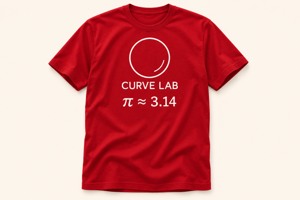
A host can run this discussion in existing clothes. If a recurring program needs a recognizable facilitator design, the linked custom cotton crewneck T-shirts for workshop facilitators list 170 GSM cotton and sizes XS–3XL. The current minimum quantity is 2. Confirm the selected color, actual size chart and print configuration before ordering; the red AI concept is not a live availability check.
Compare custom T-shirts in other styles and fits if the team needs a different garment. Confirm the final artwork with DecentCustom, including the approximation sign. The shirt supplies neither an official affiliation nor a tested teaching program, and its artwork does not specify the accuracy of a physical product.