A pet store can sell food and supplies without selling animals. It may also offer pickup, host an adoption partner or arrange a specialist delivery. Before ordering one branded bag for every transaction, identify what actually leaves your counter and what packaging it already needs.
Start with the actual retail branch
Do not infer live-animal sales from a pet-friendly shop. Wally Pets' FAQ welcomes visiting pets but says the store sells pet food and supplies rather than live pets. That distinction changes the packaging question: an ordinary retail purchase needs a different review from an animal collection.
Delivery can also have an established system. Natural Pet Pantry describes its own reusable insulated delivery containers and refrigerated van. This is evidence of that provider's existing system, not a temperature guarantee for another seller or a reason to replace the container with a printed paper bag.
Keep four packaging decisions separate
| What is leaving? | What stays in place? | What can an ordinary branded bag add? |
|---|---|---|
| Dry, nonfood retail accessories | Any product packaging, warnings and protection already supplied | Optional outer carry convenience, after checking actual size, weight, edges and handling |
| Manufacturer-sealed pet food | The original sealed bag or can and its label | At most an independently assessed outer carry role; never a replacement food-contact package |
| A temperature-sensitive delivery | The responsible provider's approved packaging and delivery system | No assumed insulation, leak containment or cold-chain function |
| A live animal or a specialist collection | The responsible specialist's appropriate container and instructions | No animal-container role; do not put an animal in an ordinary shopping bag |
Use the same separation for fragile aquarium purchases, customer-owned carriers and memorial products: preserve the appropriate original or specialist protection. This article does not prescribe animal-handling, biological transport or memorial transport procedures.
A completed counter decision
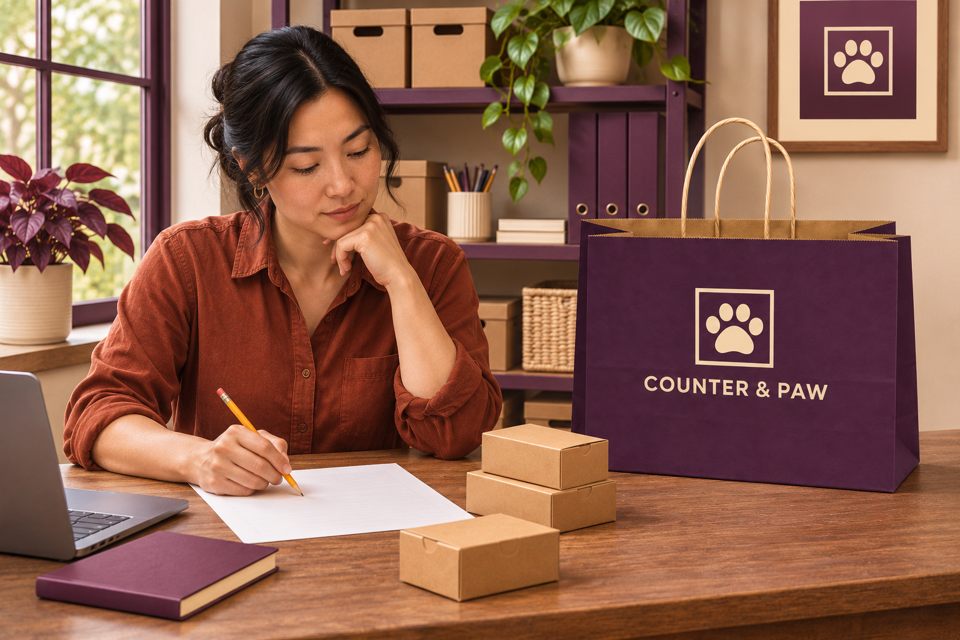
Fictional example: Counter & Paw is a food-and-supplies retailer that sells no live animals. Its buyer initially lists one new logo bag for dry accessories, food purchases and a partner's refrigerated deliveries. The counter supervisor and delivery contact review those three jobs before artwork is released.
The buyer removes the delivery job from the paper-bag brief because the partner already supplies its own specialist container. Manufacturer-sealed food keeps its original packaging and labels. The remaining question is narrow: does an ordinary outer bag help customers carry selected dry accessories?
The supervisor finds usable bags already at the counter. The proposed short trial would also use fewer than the linked candidate's currently displayed minimum quantity of 50. The completed decision is to use existing stock and place no new bulk order. A future order can be reconsidered after the actual products, carrying task and remaining stock have been checked; a logo alone does not create a supply gap.
Write a brief that leaves the packaging boundaries intact
Record the actual store branch, the items included, the existing packaging and the owner who can approve any change. Describe an outer carry task in ordinary terms. Keep food-contact, thermal, leak, load and specialist-container requirements out of a paper-bag brief unless separately supported for the exact product and use.
Check the filled purchase rather than just the empty bag dimensions. Confirm clearance, total contents, handles, edges and intended handling with the responsible buyer. If suitability remains unknown, keep the existing appropriate arrangement and hold the order. Do not cover product instructions, original labels or required warnings with branding.
An optional ordinary carry candidate
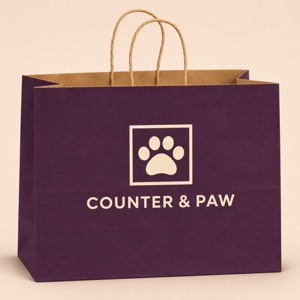
Matte paper shopping bag
The linked matte paper shopping bags for an ordinary dry retail carry need are listed as 16 W × 12 H × 6 inches, with twisted kraft paper handles and a 15 W × 9.39 H inch imprint area. The current quantity field shows 50 and a minimum of 50; the separate case-pack figure is 250.
Those dimensions and quantities do not establish a load limit, food-contact suitability, moisture resistance, insulation or animal-transport suitability. The image is an AI artwork concept, not a tested sample. Confirm the exact configuration, artwork, fit, total price and current availability before buying.
Compare other custom paper bags only after identifying a genuine ordinary carry gap. Share the actual approved brief with DecentCustom; existing stock or no new order may already answer the task.
Questions before releasing artwork
Can a branded bag replace a sealed food package?
No. Keep the original product packaging and labels. This ordinary carry candidate has no verified food-contact role in this review.
Should an adoption event use the store's shopping bags for animals?
No. Hosting an adoption partner does not turn a shopping bag into an animal container or give the retailer authority to change the partner's specialist arrangements.
Does an existing insulated container need a second logo bag?
First check what problem the extra layer would solve and who can approve it. Keep the provider's system intact; an additional branded item is optional and may add no useful function.
Source review: November 17, 2026. Named retailers illustrate different published service boundaries, not a survey of all pet stores. The linked provider descriptions illustrate existing packaging arrangements; their performance claims have not been independently verified here. The Counter & Paw example is fictional. No physical bag test, actual customer outcome or delivery-date guarantee is claimed.