Choose fish-market staff clothing for the actual tasks and the transitions between them. A shirt proposed for a dry order desk has not automatically been reviewed for packing, wet work or the shop’s laundering process. Resolve those differences before approving one logo shirt for everyone.
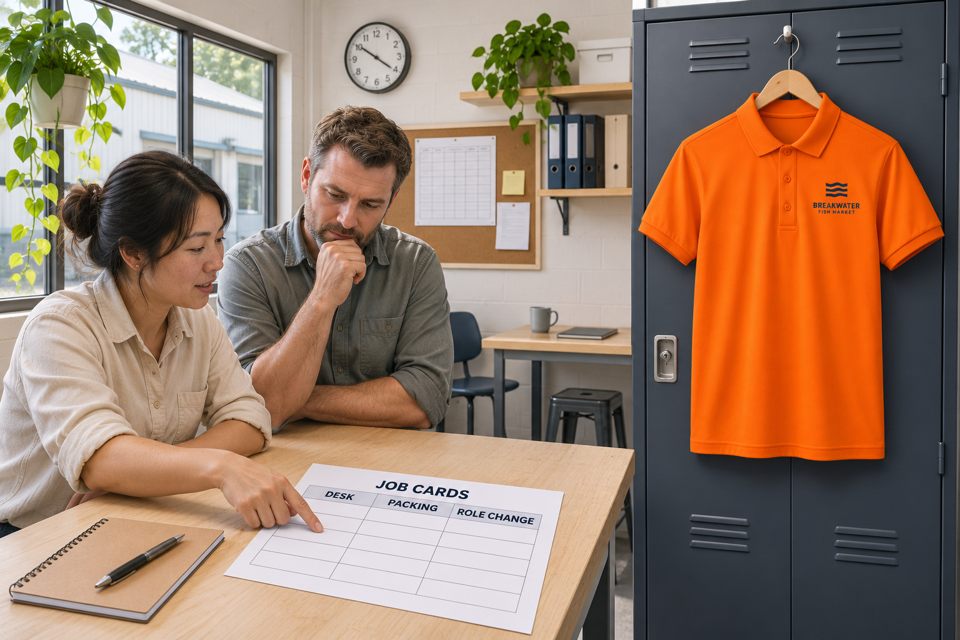
Describe what people do, not just their job titles
A fish market may have customer-service work and very different packing activities. Pike Place Fish Market’s shipping article describes staff wrapping seafood, packing an insulated box and sealing it. It does not establish what clothing another store should issue, or provide evidence about the pictured polo’s performance.
The same distinction applies to seafood carrying accessories: the presence of a logo does not establish suitability for a different task. First identify the shop’s actual work, existing requirements and person responsible for approving the clothing proposal.
Breakwater Fish Market and the following assignments are fictional. They illustrate a review before purchase, not observed staff practices at a real business.
Jules: a dry order-desk assignment
Jules answers order questions and uses a computer at a dry desk. A manager proposes an ordinary branded polo for this assignment. The next questions are the actual garment’s fit, comfort during those tasks and compatibility with the shop’s required care process. The proposal remains limited to this defined work.
Dev: packing work with different requirements
Dev’s assignment includes the shop’s packing operation. The responsible manager must identify its actual clothing and protection requirements, including relevant exposure and cleaning conditions. The dry-desk proposal does not answer those questions. Keep the existing suitable task-clothing process while the new option is unresolved.
Jules is asked to help with packing
This is a change of work, even if it lasts only a short time. Before assigning it, the supervisor needs to resolve the applicable task requirements and how the shop handles the transition. Wearing the same logo as Dev is not approval to perform Dev’s work in the proposed desk shirt.
If that transition has not been reviewed, do not label the garment a shop-wide uniform. Record the unresolved assignment and who will decide it.
Review fit using the actual duties
For an ordinary desk-clothing proposal, ask the wearer which movements the job requires. Reaching a frequently used shelf, sitting at the actual desk and using the normal work surface may reveal different fit questions from standing still in front of a mirror.
Plan any review with the responsible supervisor under the shop’s applicable procedures. Do not stage hazardous work or handle food merely to demonstrate a shirt. The aim is to identify garment restrictions during an appropriate review, not to turn a promotional photo into evidence of protection.
A useful record can remain unfinished
Proposed use: Jules’s dry order-desk assignment only. Packing work is outside the current proposal.
Before a sample review: obtain the current size chart, identify the actual selected size and configuration, agree which ordinary movements will be assessed and confirm the applicable care information.
During an appropriate review: record what the wearer actually reports about collar, shoulder, sleeve, torso and hem movement for those duties. Identify the garment and size reviewed, not simply “medium approved.”
Current status in this example: no sample has been reviewed, no movement result has been obtained and no size is approved. A label such as “regular fit” cannot fill those empty fields.
After any agreed care review, reassess the relevant fit and appearance rather than assuming they remain unchanged. Keep the evidence tied to that exact garment, customization and process; it does not establish results for every size or color.
Compare the required wash process with complete care information
Ask whoever manages the shop’s clothing process what it actually requires: the washing and drying method, applicable agents, turnaround and handling arrangements. These are information to obtain from the real operation, not settings supplied by this blog.
Then obtain the garment’s complete care instructions and confirm whether the intended customization changes them. If information is incomplete or conflicts with the required process, leave the purchase on hold or review another suitable garment. Changing the shop’s established requirements to accommodate an unverified shirt is not a purchasing decision to make from a product photograph.
Keep separate questions separate. A fabric description is not a verified drying time. A care note is not a completed wash test. An ordinary logo polo does not establish water resistance, cut protection or other protective performance. Where the actual task has specialized requirements, the responsible shop team must address them through its appropriate process.
Give the supplier the defined job and the open questions
Mara’s fictional request for information
Hello,
We are reviewing an ordinary logo polo for a dry customer order desk at Breakwater Fish Market. This inquiry does not include approval for seafood packing, wet work or specialized protection. A staff member’s possible move into packing is a separate unresolved assignment for our supervisor.
For SKU decentcustom-cl-000043, please provide the current size chart, how its measurements are taken and the available color and size configuration. We have not chosen a final wearer-size allocation or approved fit from a photograph.
Please provide complete washing and drying instructions and the applicable instructions for the proposed decoration. The listing’s temperature note does not identify its unit; please clarify it rather than assume a unit. Our manager will compare that information with the actual required clothing-care process.
Please also identify the sample or review options and any associated conditions or charges. We have not received or tested a sample, and this message does not authorize production or a purchase.
Once role, care and fit questions are resolved, we will confirm the actual quantity and request the complete configuration price, applicable shipping and tax, and production and delivery dates. Please keep the minimum order and case-pack quantity distinct.
Thank you,
Mara, Breakwater purchasing
The supervisor owns the job definition and any role change; the wearer supplies actual fit feedback; the care-process owner evaluates compatibility; purchasing assembles the approved configuration. Those roles may belong to the same person in a small shop, but each unanswered question still needs an answer.
What the current polo listing tells you
Compare custom polo shirts against the defined ordinary-clothing brief. Suitable existing garments remain an option. Do not derive a staff count, reserve quantity or buying requirement from a minimum of two.
Approve a particular use, then the artwork
A useful decision names the duties covered, the exact configuration reviewed, the care information and any unresolved role transition. Bring that specific brief to DecentCustom when customization is appropriate. A shared logo can identify a team; it cannot answer every member’s clothing requirements.