Plan cheese catering in separate parts: the food order, individual guest supplies, shared serving tools and the work of receiving and setting up. Confirm what the venue already provides before adding optional items. Twenty guests alone does not specify how many boards, tools or printed signs to buy.
A cheese board is not the whole event specification
Murray’s catering page asks buyers for event timing, guest count, menu selections with sizes and quantities, delivery details and whether plates, napkins and serving utensils are needed. It also distinguishes an inquiry from an order confirmed through its team and payment. This is one New York operator’s process, not every cheese shop’s policy.
Use that distinction to ask four practical questions about the actual order:
- Food and its serving format
- Which current menu items and sizes are being requested? What does the seller say they include, and how do they relate to the rest of the meal? Ask the caterer to review the proposed quantity rather than inventing a universal board-per-person rule.
- Individual guest supplies
- Who provides plates, napkins and any personal cutlery required for the agreed menu? A venue saying “we have dishes” is less useful than confirming which suitable items will actually be available.
- Shared serving tools
- Which tools are needed for the actual foods and serving arrangement, and are they included? Guest forks do not answer the question of how food gets from a shared board to a plate.
- Delivery and setup work
- Who receives the order, where does the courier hand it over and who carries out the agreed setup? A delivery booking does not by itself establish a staffed event service.
The separate guide to catering platters and guest supplies also distinguishes the food selection from accessories. For a cheese event, make the shared serving arrangement explicit rather than assuming a platter automatically includes every guest’s equipment.
Send the caterer a request they can actually review
Linden Rind Cheese, the event, people, address and quantities below are fictional. The example is an unsubmitted planning inquiry, not a real Murray’s order or a description of its menu.
Dana’s cheese-reception inquiry
Hello Linden Rind team,
We are planning a reception for 20 guests on Saturday, November 21, 2026, starting at 5:00 p.m. Eastern time. Cheese is intended as part of a reception before a separate dinner, not the entire meal. The room has four guest tables with five seats each and a separate proposed serving station.
We are considering three cheese boards, but have not selected menu items or sizes. Please recommend a suitable current menu proposal for this use and explain the included accompaniments, serving format and quantities. Three boards is our starting request, not an approved serving calculation.
The fictional venue is Example Hall, 22 Example Mews. We would like to request a 4:30 p.m. arrival, subject to your confirmation. I will be the receiving contact; direct contact and access details will be supplied through the private order channel. Please tell us the actual handover and setup arrangements before we book.
Our venue coordinator, Ellis, has confirmed that 20 suitable guest plates and 20 napkins will be available. We have not confirmed personal cutlery or shared serving tools. Please specify what the proposed menu needs and which items you can include, with any separate charges. Please do not automatically add another set of plates and napkins.
We have not requested drinks or cups. We will also collect any dietary questions from guests and discuss them directly with your team before agreeing the menu; this message does not assert that any particular accommodation is available.
Please send the complete proposal, delivery and other applicable charges, payment requirements and the steps needed to confirm the order. We understand that this inquiry has not reserved food, a delivery time or event staff.
Thank you,
Dana, event host
The useful detail is not the fictional number of boards. It is the explanation of their role in the event, the venue’s confirmed contribution and the items still unresolved. The caterer can then review a defined request instead of guessing what “catering for twenty” means.
Read back the responsibilities before accepting the proposal
In this fictional continuation, Dana and Ellis review the request before any caterer response. Their record should preserve that status rather than making the plan look fully approved.
The host-and-venue planning record
Guest layout: four tables × five seats = 20 planned guest places. This checks the seating plan only; it does not establish cheese portions or board yield.
Venue-confirmed contribution: Ellis will make the stated 20 guest plates and 20 napkins available. Any extra allowance, replacement arrangement or change in count still needs its own decision.
Food proposal: three boards requested, with menu items, sizes, accompaniments and adequacy awaiting the caterer’s review. Do not mark food quantity confirmed.
Unresolved supplies: personal cutlery and shared serving tools. Dana will ask the caterer what the actual menu needs, what is included and what must come from the host or venue.
Receiving and setup: Dana is the proposed receiving contact. Arrival time, handover point and the party responsible for setup remain subject to agreement; no event-service staff have been booked.
Purchase status: inquiry only. No catering response, accepted total, payment or confirmed delivery arrangement is recorded in this example.
After the seller responds, update each item with the actual agreement and its owner. A document headed “event confirmed” should not conceal unresolved tools or a setup task that neither party has accepted.
A changed guest count can affect several decisions
If more guests are added, ask the caterer to review the food proposal and ask the venue to review guest supplies and layout. Do not merely add a few napkins while leaving the rest of the agreed event unchanged.
Similarly, changing from a reception before dinner to the main meal changes the brief even if the headcount stays the same. Moving the food to several serving locations can change the shared-tool and setup questions. Record the revised arrangement and obtain the relevant confirmations before treating the old proposal as suitable.
Keep menu and dietary questions with the actual catering team. A printed name card or a host’s assumption cannot establish ingredient information or an accommodation the seller has not confirmed.
Use a printed prompt only for a real information need
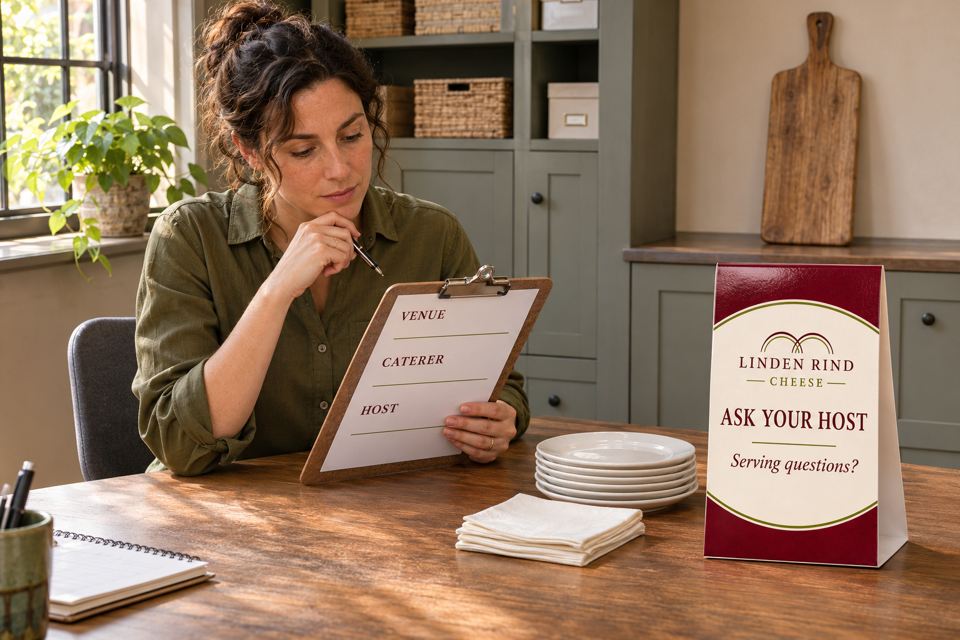
Compare table tent formats only after identifying that need. An existing suitable sign or direct host communication may suffice. The artwork does not establish moisture resistance, cleanability or food-contact suitability, and it does not replace the actual menu information.
Finish the service plan before adding branded supplies
Agree the menu, guest items, shared tools and receiving/setup responsibilities first. When a stable printed message is justified, bring that wording and the actual quantity to DecentCustom. The most useful accessory is one that supports an agreed service rather than compensating for a question nobody has answered.