A dairy-store purchase and a scheduled home delivery are different service records. Explain whether the customer is choosing a shop, registering interest, waiting for address activation or reviewing an actual order. A familiar brand name does not confirm coverage or put products on a delivery route.
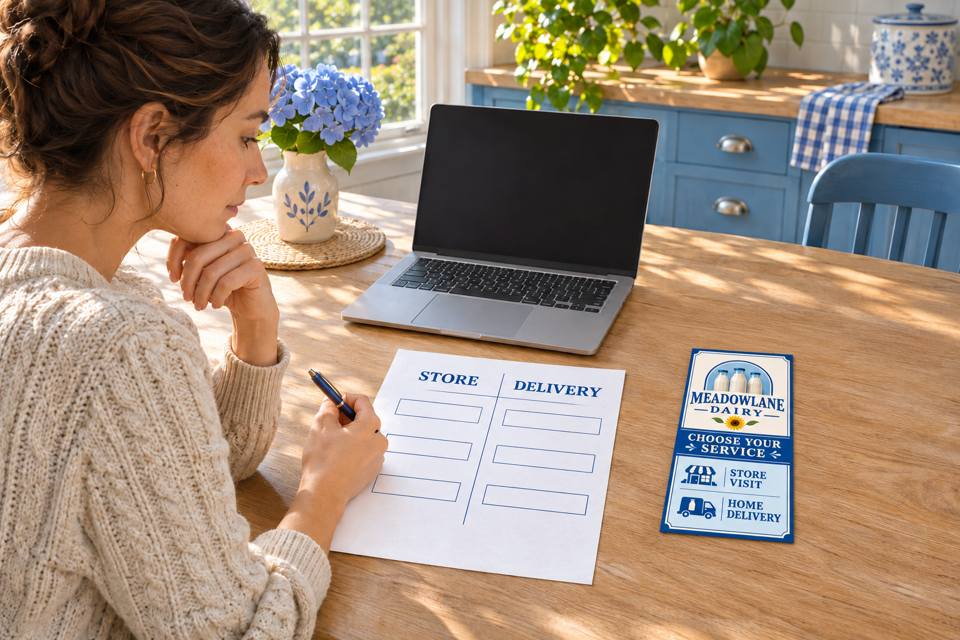
Start with the channel the customer intends to use
The Danzeisen Creamery Stores site lists physical locations in Payson and Laveen. The separate Danzeisen delivery FAQ describes registration, an area waiting list and notification before delivery ordering. It also treats apartment access individually. A shop listing does not establish that a given home address is active for delivery.
Those pages are one operator example, not proof that every dairy business has the same channels or account arrangements. They do not establish that every retailer selling a dairy’s products has the same ownership or can approve delivery for the brand.
- Store visit
- Confirm the actual location, current hours and the product or service needed with that shop. A product bought at the counter is a retail transaction, not evidence of a recurring home order.
- Delivery registration
- A service may collect interest or create an account before it serves the address. Record that status accurately rather than announcing a booked delivery.
- Address or service activation
- Obtain the actual service’s notification and applicable access arrangements. Being eligible to order is still different from selecting the products and delivery date.
- Scheduled order
- Review the real products, quantities, date, terms and status in the delivery service’s own order process. Do not manufacture that record from a shop receipt or a registration email.
Keep the completed purchase and open delivery question separate
Meadowlane Dairy, its people and the records below are fictional. Assume this example has two distinct records; no actual customer account, address or transaction has been accessed.
S1 and H1 answer different questions
S1, retail: Finn’s counter purchase is complete in the fictional store record. This says what happened at the store; it does not create a subscription or transfer products into a future delivery.
H1, home service: Finn has registered interest, and the fictional delivery record is still waiting for the address to be activated. There is no selected delivery date or accepted product order in H1.
Open question: Finn wants to know whether registration means milk will arrive next week. The answer must come from H1’s actual service status and ordering process, not from the fact that S1 exists.
Do not collapse those into “customer signed up, order complete.” Retain the source of each status so a colleague can tell whether they are looking at a retail receipt, a waiting-list notice or an actual scheduled order.
Let the customer explain the intended next step
Finn’s unsubmitted service question
Hello Meadowlane team,
I bought milk from your store and later registered for home delivery. The registration message says I am waiting for service at my address. I would like to know what needs to happen before I can place a delivery order.
I have not selected products or a delivery date in the home-service account. Does my current status allow ordering, or do I need a separate activation message first? Please tell me which team can check it through the appropriate private account channel.
I live in an apartment, so please also explain how the delivery team reviews building access before any arrangement is confirmed. I will provide the necessary address and access details privately rather than include them in a public message.
I also have empty bottles from my store purchases. Please tell me which return process applies to those bottles. I have not assumed that a store return automatically becomes a credit on a delivery account.
Thank you,
Finn
The question supplies the actual uncertainty and avoids inventing a delivery date. It also separates the new home-service request from the existing retail purchase and return question.
Answer only the status the team has established
For this fictional response, assume Mei has checked S1 and H1 as described above. This is an example of clear wording, not a real Meadowlane or Danzeisen customer-service response.
Mei’s counter-team response
Hello Finn,
Your store purchase S1 is recorded as complete. Your home-service record H1 is a separate registration and is still waiting for address activation in this example. We have not established a scheduled delivery order for you, so I cannot confirm that milk will arrive next week.
Please use the delivery service’s official account or contact route so its team can review the address and apartment access. If service becomes available and you receive the appropriate notification, follow that service’s order process to choose the actual products and delivery date. An activation message alone should not be described as a completed order.
For questions about a new store visit, contact the actual shop to check the current location details, hours and the product you need. That is a different question from opening the home-service route.
For the empty bottles, we need the brand, bottle type and applicable purchase/return arrangement. We have not transferred a store refund or exchange into H1, and we should not promise that result without confirming the relevant terms.
Please keep any account, address and access details in the appropriate private service conversation. We can then direct each unresolved question to the responsible team without marking an unplaced delivery order as confirmed.
Thank you,
Mei, Meadowlane counter team
If a delivery team later changes H1’s status, record that actual update and its next action. Do not overwrite the earlier waiting-list state in a way that makes it appear a delivery was already booked when the customer first registered.
Keep return terms tied to the receiving channel
The guide to dairy bottle-return exceptions compares specific return arrangements and explains why bottle type and receiving retailer matter. Use the actual terms for the current return; a shared brand name does not establish that all counters and delivery accounts process it identically.
The same discipline applies to recurring orders, changes and skips. Check the real delivery record and process. A retail receipt, an unsent question or a plan to skip is not itself a change to that record.
Make the service-information card direct the right question
Compare rack card formats only if a stable printed explanation would help. Existing official web information or direct staff communication may suffice. A delivery service’s existence does not create a need or permission for vehicle signage, new bottles or giveaways.
Name the service, the status and the next action
Keep a completed shop purchase distinct from waiting-list registration and an actual scheduled order. Tell the customer where the specific open question belongs. Bring verified public service wording and the actual print quantity to DecentCustom when a card is justified; the card’s job is to explain the route, not confirm it for a particular address.