Choose dairy carryout materials around the actual bottles and the shop’s handling arrangement. Full milk bottles, empty returns, bottle support and required cold storage are separate questions. A bag described as holding four wine bottles does not establish that it fits four dairy bottles or keeps milk appropriately cold.
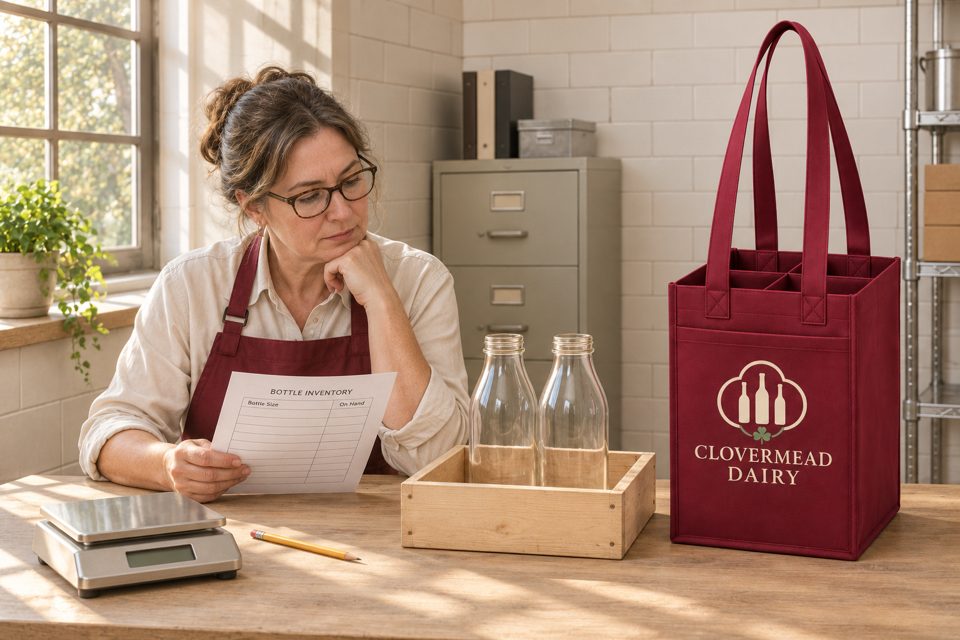
Define three jobs before choosing a printed bag
Bottle containment and support: establish how the actual containers will be held, separated where necessary and supported through the intended handling. A divider’s presence alone does not establish adequate clearance, restraint or protection for another bottle shape.
Carrying and transfer: identify who moves the load, between which places, and with what arrangement. Moving a customer’s purchase from counter to their existing container is different from repeated staff transfers or parcel shipping. Do not extend a shop carryout decision to a delivery route or a shipping package without a separate review.
Cold storage: retain the applicable product storage instructions and the dairy’s established arrangement. An open promotional carrier has not been shown to provide refrigeration. This article does not prescribe storage temperatures or allowable time outside refrigeration; the bag choice cannot supply missing food-handling instructions.
Start by asking what the existing bottle carrier and cold-storage arrangement already do. If both are appropriate for the real task, a new printed bag may add no necessary function. A label or separate service-information piece may be the only communication change required.
Keep empty returns distinct from full outbound bottles
Homestead Creamery describes an existing glass-bottle return program. That supports checking the current return arrangement before proposing new bottles. It does not tell us the dimensions, filled weights or appropriate carrier for another shop.
Three empty bottles being brought back and two full bottles leaving are different loads. They may use different containers and occur at different stages of the visit. Do not combine the counts into “a five-bottle purchase,” or infer that a bag suitable for the empties is suitable for the filled bottles.
Physical handling also does not determine return eligibility or credit. Check the applicable dairy bottle-return exceptions separately. A bottle visible at the counter has not necessarily been accepted into the return program.
A useful bottle record can end with “not yet decided”
The following Clovermead example is entirely fictional. It illustrates what is known and what still prevents a carrier decision; no actual bottle was measured or weighed.
Carryout review C35
Outbound task: two filled dairy bottles, one of each of the shop’s two bottle formats. The customer will collect them at the shop. The bottle formats have not yet been measured, and their actual filled weights are unknown.
Return task: three empty bottles arrive in a separate existing container. Their acceptance and any credit still require the shop’s return review. They are not additional filled bottles in C35’s outbound load.
Existing arrangement: the team has an established bottle carrier and a separate cold-storage process. The manager has not identified a documented carrying problem or approved replacing either arrangement.
Candidate status: a divided wine tote is being considered for its carrying format and optional shop identification. No sample evaluation, milk-bottle fit check or supported load information is available.
Decision: keep the existing arrangement. Gather the missing bottle and candidate information before deciding whether a sample evaluation is justified. No production order is approved.
There are two outbound bottles and three described returns, but no supported total load weight. Unknown weight is not zero. Likewise, the presence of four advertised pockets does not establish usable space for the two actual bottle formats.
Read a divided wine-tote listing at its actual scope
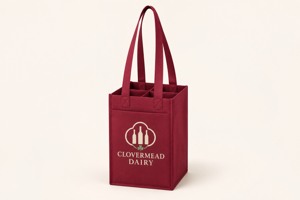
A conditional carrying-format candidate
The four-compartment wine tote, SKU decentcustom-to-000772, lists 80-gram polypropylene, a bottom insert, collapsible dividers and a front pocket. Its stated overall dimensions are 11 inches high by 7.25 wide by 7 deep, with 22-inch handles.
Those overall measurements are not individual divider-cell clearances. The listing does not establish milk-bottle compatibility, an applicable filled-load rating or cold-storage performance. Ask for relevant information before treating this wine carrier as a dairy solution.
The current quantity control showed a minimum of 100 when reviewed on November 8, 2026. That is not a recommendation to order 100 or confirmation that a single sample can be purchased. Check current options and sample availability separately. Compare bottle-carrier formats by their actual construction, not their printed artwork.
AI artwork concept only. The empty burgundy bag’s Clovermead logo illustrates identification; it does not verify construction details, milk-bottle fit, carrying strength, insulation or physical performance.
Send enough information for an honest suitability discussion
This complete example is an unsubmitted fictional request. Replace its unknowns with actual observations before seeking a decision.
Amelia’s proposed supplier inquiry
Hello,
We are reviewing a carrier for two filled dairy bottles collected at our shop. We are considering SKU decentcustom-to-000772, but understand that its listing describes a wine tote rather than an approved milk-bottle carrier.
Our two bottle formats have not yet been measured or weighed when filled. We will provide their maximum outside widths, heights, shapes and actual filled weights before requesting a suitability assessment. Please explain which additional dimensions or handling details you need.
Please provide the usable divider-cell dimensions, the bottom-insert and handle construction information, and any applicable supported load or use limitations. Tell us what information is unavailable rather than treating the overall bag dimensions as cell clearances.
We have not approved replacing our existing bottle carrier or cold-storage process. We are not asking this open bag to provide refrigeration or to serve as a parcel-shipping package. Any evaluation must address our actual shop task, including how the bottles are supported and transferred.
Please confirm whether a suitable sample-evaluation route is available before a production purchase. If the candidate is unsuitable or cannot be assessed, please say so. We will keep our existing arrangement while the decision remains open.
Thank you,
Amelia, fictional Clovermead purchasing coordinator
Decide about the carrier before approving its artwork
Record a clear outcome: retain the existing arrangement, obtain missing information, evaluate a suitable sample through the responsible team, or reject the candidate. Keep “information requested” distinct from “fit confirmed” and “order approved.” An attractive mockup cannot close those gaps.
Only after the physical use is established should the shop approve its identification artwork, actual quantity and complete quotation. Keep any chosen design clear of necessary product information and avoid claims that the evaluation did not establish.
Bring a verified carrying brief to the next step
When the actual container and task are understood, share the relevant bottle and artwork brief with DecentCustom. If existing materials already serve the job, retaining them is a complete decision. Printing a logo is optional; establishing suitability comes first.
Research scope: the prepared dairy-industry workbook, Homestead’s public return-program description and the current DecentCustom product listing. Operator policies are not evidence of this candidate’s performance. All Clovermead people, records and artwork are illustrative; no customer inquiry, test or order occurred.