A wall of workshop notes is a starting point. Before clearing it, preserve what people proposed and leave with a concept someone can review, test or deliberately hold. Here is a worked example for a creative studio planning team.
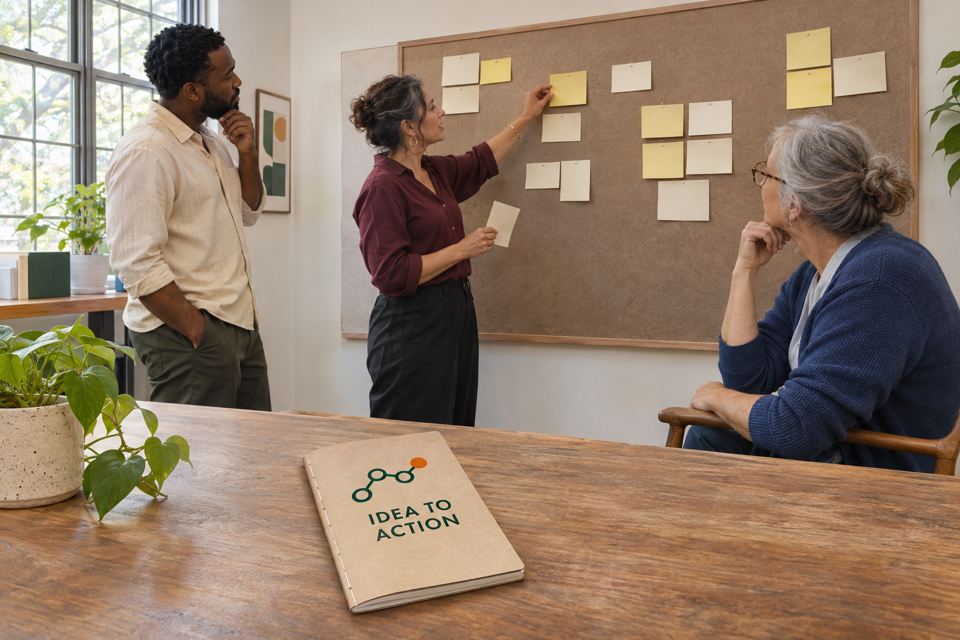
Decide what the session should leave behind
For a World Creativity and Innovation Day activity on April 21, a studio team could investigate one part of a visitor's experience. The useful output is a clearer proposal and its next question, rather than a photograph of a busy wall.
Start with one audience and one situation. A first-time class participant, an independent member and a company booking an event need different arrangements. A session about welcoming beginners should not quietly become a redesign of membership access or technical training. Write the intended decision where the group can see it: “Which first-visit welcome concept should we investigate next?”
Agree who can make that decision. The person hosting the discussion may not control reception staffing, booking messages or the teaching schedule. Their contributions matter, but a suggestion to add a new service still needs the relevant owner's review.
Keep the original suggestions while assembling something useful
Read the notes together and ask their contributors to clarify ambiguous wording while they are present. Give each original note a simple identifier before moving or summarizing it. Keep an ungrouped area for ideas that do not fit; do not force a different problem into the largest cluster.
IDEO.org's Bundle Ideas method moves beyond grouping similar notes to combining useful elements into more developed concepts. For a studio team, keep a separate list of source-note identifiers beside each proposed combination. That makes it possible to distinguish what people actually suggested from the facilitator's interpretation.
A cluster's size is not evidence that customers want it. Several notes may come from one person, describe the same incident or repeat an assumption. Record the reason for considering a concept, including any conflicting suggestion. If the team uses a preference vote, keep that result separate from evidence about customer needs.
Give a promising concept enough detail to question it
IDEO.org's Create a Concept activity returns to the original design question as ideas become a more complete proposal. A useful studio record should let a colleague understand the proposal after the wall has been cleared.
Use these headings: audience and situation; source suggestions; proposed experience; people and resources it depends on; what remains unknown; next action and owner; review point. Add the current status, such as “proposal awaiting reception review.” Keep a link or reference to the original notes.
Separate an observation from a suggestion. “Ask whether newcomers can identify the check-in point” is a research question. “Newcomers always get lost” is a factual claim requiring evidence. If nobody has checked, retain the question rather than making the record sound more certain.
A worked example: a first-visit welcome concept
The following is invented to show the record in use. No staff or visitor responses have been collected.
Audience and situation: an adult arriving for a first booked class at the fictional Idea to Action studio.
Source suggestions: note A proposes a clear welcome point; note B proposes a staff greeting. A separate suggestion about member storage stays outside this concept.
Combined concept: the booking message identifies the existing welcome point, and the assigned host confirms the visitor's next step on arrival.
Dependencies: the reception lead checks that the point exists and can be staffed; the booking-message owner checks the current confirmation wording.
Unknown: can a newcomer identify what to do if the host is briefly unavailable?
Next action: the reception lead reviews an arrival walkthrough with the instructor before any visitor-facing change. The actual lead's name and agreed review date still need to be entered.
Status: proposal only. Hold public instructions until the responsible people agree on a workable fallback.
Walk through both the intended experience and a plausible difficulty. In the first sketch, a visitor arrives, recognizes the welcome point and meets the host. In the second, the host is helping someone else. What can the visitor reasonably do next, and who supports that step?
The GSA Digital.gov storyboarding framework uses ideal and real-world scenarios to expose interactions, stakeholders and assumptions. Simple drawings or written frames are sufficient for this discussion. In this example, the missing fallback is a question to resolve, not a reason to print “staff always available.”
Close with a reviewable handoff, including a valid hold
Read the record back to the group. Confirm which parts are suggestions, which have been checked and who accepted the next action. If nobody can take responsibility, mark it unassigned and keep the concept on hold. Do not turn the facilitator's summary into an announcement that a service is launching.
At the review, record the decision and its reason: investigate further, revise, use an existing solution or stop. Preserve the unresolved question even when the artwork looks finished. If the next task is testing how visitors interpret wording, see how to test one studio pickup message with a specific learning question.
Use the record format your team can maintain
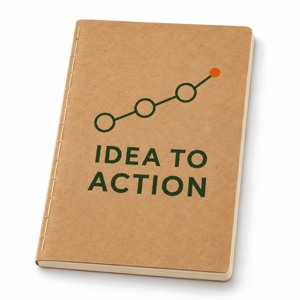
An existing shared document or plain notebook may already serve the team. If there is an ongoing paper-record need, these kraft-cover notebooks for ongoing studio planning notes list A5 size, a paper cover, compact stitching, 80 sheets and blank pages by default. The current minimum is 12; that does not establish a need to give every participant a new notebook.
The AI cover is a concept, and the linked item does not come with the example worksheet printed inside. Compare custom padfolios and notebooks and review the actual configuration with DecentCustom only after deciding how the record will be used and shared.