Useful cheese-class materials do more than advertise a date. They help a learner reach the correct session, identify each sample, record personal observations and find the right product information afterward. Give those jobs separate spaces, especially when the planned tasting selection changes.
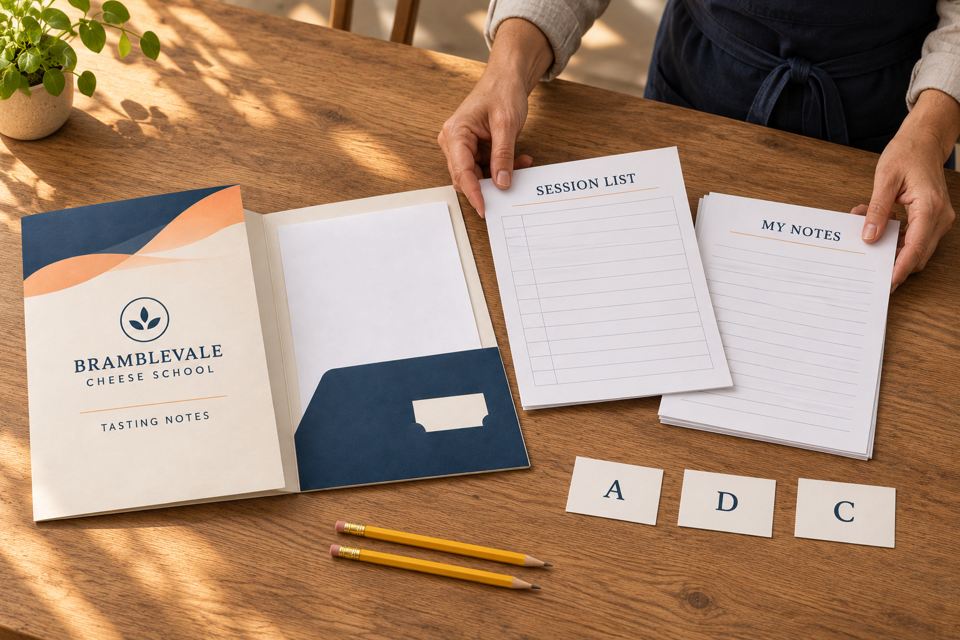
Give each piece of information a job
Murray’s official classes site distinguishes in-person, virtual and private experiences. Those formats need different joining information. Its program is a real example of cheese education, not evidence that every shop offers the same sessions, dates or materials.
- Arrival or joining note
- Identify the booked session, full date and year, local time and time zone, exact venue or joining route, arrival instructions and a current contact. Keep a public event announcement distinct from a participant’s confirmed booking.
- Current sample list
- Connect the actual samples to their codes, serving positions and verified product identities. Include a session identifier and version so a replacement is not silently given the old sample’s description.
- Learner worksheet
- Provide space for the learner’s own observations and questions, tied to the sample code. Keep those observations separate from facts supplied by the instructor or product information.
- Follow-up information
- Help the learner identify a cheese they enjoyed and ask about current availability or further learning. A class note should not become an unverified promise that the shop always stocks the same product.
For order-based services, the related guide to order and pickup confirmations separates a request from an accepted arrangement. Apply the same care to a class booking without treating a catering confirmation as a class ticket.
Verify the actual event details before printing. A holiday promotion without a clear year, an old poster or a shop’s ordinary opening hours is not enough to establish a particular class’s arrival time.
Make the sample map reliable before the class begins
In the fictional Bramblevale Cheese School example, session L31 originally planned codes A, B and C at positions one, two and three. The instructor replaces the second selection before the session. The replacement receives code D, and the session list is revised to version 2.
The sequence is now A, D and C. Position two still exists, but it no longer identifies sample B. The instructor must connect D to the actual replacement’s verified product record and update the relevant teaching information before using the revised packet.
Do not transfer B’s product name, producer or ingredient information to D merely because it occupies the same position. Keep an explanation of the change so staff and learners can understand why an older sheet differs.
This is a fictional materials example, not an instruction to change an actual class’s food selection. The responsible teaching team must handle any real substitution and participant questions through the event’s applicable process.
Explain the revision to the people using it
The session, venue, people and actions below are fictional. Assume that instructor Tessa has verified the revised sample identities and issued list L31-2 before the class. No real food, class booking or student has been verified.
Tessa’s session-opening note
Welcome to Bramblevale’s introductory cheese comparison session L31 on Saturday, November 28, 2026. Our fictional session runs from 2:00 to 3:30 p.m. Eastern time in the teaching room at 18 Example Court; the arrival note identifies the teaching-room entrance and a 1:45 p.m. check-in.
Today we will practice describing our own observations and comparing preferences. Please use session list L31-2. The sample sequence is A, D and C. D is the replacement at position two; the earlier list’s B is not being served in this example.
Please put the actual sample code beside each note. If you have already written a note under B for the replacement actually served at position two, ask me to confirm that mapping before relabeling it. If you are unsure which sample a note describes, leave that uncertainty visible rather than guess.
Use the current list and my verified product information for product names and other factual details. Put your own aroma, texture and preference observations in the separate “My notes” space. An association such as “toasty” is your description, not an ingredient declaration.
Before leaving, ask us to identify any sample you want to find again. Keep L31-2 with your notes so a later conversation refers to what was actually served. Current product availability and purchasing details need a separate check.
Thank you,
Tessa, fictional session instructor
The arrival details establish which fictional session the note addresses; they are not a current event listing or invitation. The instructor’s revision explanation does the useful work of connecting the papers to the actual sample map assumed in this example.
A learner note should preserve observation and uncertainty
Rose’s worked note for the replacement sample
Session and list: L31, November 28, 2026; current list L31-2.
Sample: D, position two, after Tessa confirms that mapping. An earlier B heading on this sheet is marked as superseded rather than silently reused.
My observations: “The texture seemed crumbly to me. The aroma reminded me of toasted bread. I preferred it to A in this comparison.”
Product facts: use D’s verified identity on L31-2. Do not infer milk type, ingredients, production method or an accommodation from these tasting impressions.
My next question: “Can you help me identify D from this session list and check whether it is currently available?”
Rose and the tasting impressions are invented for this example. Their value is the structure: a traceable sample reference, a clearly personal observation and a question someone can answer. “Everyone will love this cheese” would overstate an individual preference; “I liked number two” would be hard to act on after the menu changes.
If the sample identity remains uncertain, retain the note as uncertain and ask the instructor. Neat stationery cannot recover a missing connection between a note and the item described.
Choose the packet format after defining its contents
Compare presentation folder formats against the real class need. Existing folders, ordinary loose paper or an appropriate digital packet may already work. A minimum of 100 is not a forecast of attendance, a reason to create a gift program or evidence that one class needs branded folders.
Make learning easier to refer back to
Check the event details, maintain the actual sample map and give learners room for their own observations. Only then decide whether a branded packet adds something useful. Bring that specific materials brief to DecentCustom when printing is justified; the purpose is a clearer learning record, not stationery for its own sake.