Review cheese carryout materials around the complete existing package and the actual handover. Check how it must be carried, which information must remain accessible and which units belong to each order. An extra bag or logo label should support those jobs without replacing the original packaging or its instructions.
Keep the existing package’s job visible
A wrapped retail piece, a closed catering board and a parcel prepared for shipping can have different arrangements. Obtain the actual package description from the responsible shop team before choosing an outer carrier. Do not assume the same bag is suitable merely because all three orders contain cheese.
Murray’s shipping support information describes a thermal-lined box and gel packs for its website orders. That is an operator’s packing arrangement, not evidence that an ordinary branded carry bag supplies equivalent functions. Its shipping description also should not be treated as the specification for every local catering order.
For the actual carryout job, record the completed package’s dimensions, required orientation, closure, supplied information and intended handling arrangement. If a board must stay level under the shop’s actual instructions, the carrying proposal needs to accommodate that condition. Turning or compressing it to get through a narrow bag opening changes the proposal.
Keep the original closures and information intact. Check whether a carrier hides a label, places a handle across a closure or makes the complete package awkward to access. A catalog’s outside dimensions do not by themselves establish the usable opening or a suitable arrangement.
Where the existing appropriate carrier already works, there may be no reason to add another one. If a new arrangement is unresolved, retain the existing suitable process rather than removing packaging to make an accessory fit.
One counter can hold more than one order
The following Rindhaven Cheese example, people, order codes and decisions are fictional. It concerns matching handover units, not real orders or a demonstrated packaging method.
Two units for S32; one separate unit for S33
Order S32 has one intact food box and one separate dry guest-supply bag in its current record. Order S33 is a different customer’s single wrapped parcel. All three units are near the same counter, but they are not one three-unit order.
Iris, the fictional packing lead, has to confirm the actual contents and suitable packaging through the shop’s process before any outer grouping is treated as complete. Leo at the order desk then needs to match that group to the correct collection record.
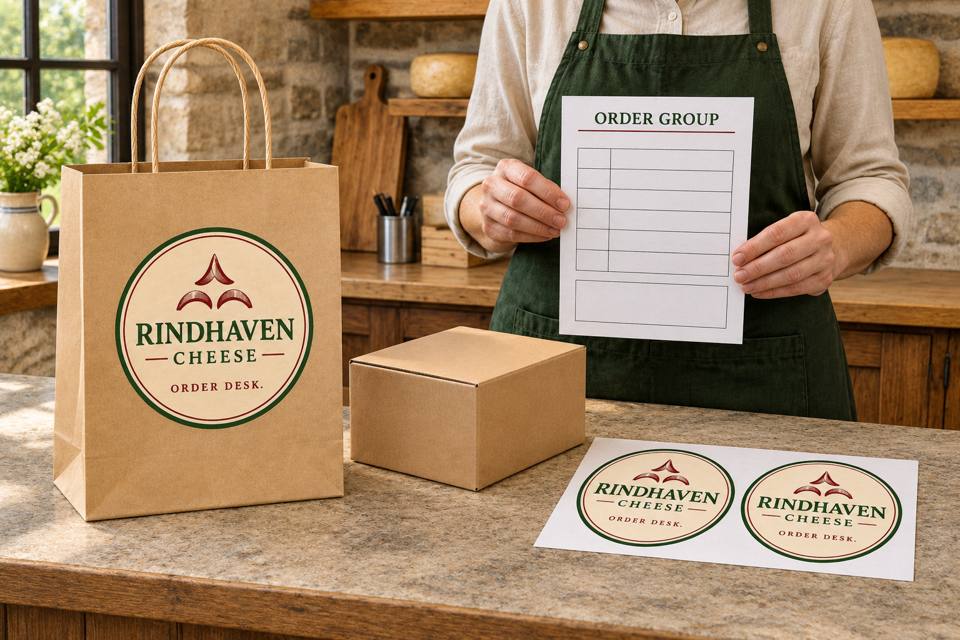
A proposed group reference for S32 could identify its two confirmed units as 1 of 2 and 2 of 2; S33 remains a separate 1-of-1 group. Use a permitted identification method that suits the actual surface and workflow. This example does not establish that the pictured brand label can be written on, that variable-data printing is available or that it belongs on a food wrapper.
A brand mark says where a material is intended to come from. It does not say that the correct contents are inside or that all of an order’s units are present. Keep the operational reference connected to the current order record rather than expecting a logo to do that work.
Write the intended label job before selecting a material
Iris’s draft outer-identification brief
Hello,
We are reviewing a Rindhaven brand identifier for a permitted dry outer surface used with an already appropriately packed carryout order. It will not replace the original food packaging, closures or supplied product information.
Before recommending a label configuration, please identify what surface, dimensions and use conditions you need us to confirm. We will provide the actual proposed location after our packing lead checks it. Do not assume that the label will be applied to a cold, damp or food-contact surface.
The artwork should keep the shop name clear without covering the existing information or interfering with closure and handling. The order-group references change between orders. Please explain any supported method and its conditions if variable references are proposed; otherwise we may retain our existing separate identification method. We have not approved handwriting or a particular printing workflow.
Please distinguish the finished label size and material from its sheet or other ordering unit. The illustrated two-label sheet is only an artwork concept, not a confirmed production layout or yield.
We have not established adhesion, moisture resistance, carrying performance, a temperature duration or shipping suitability. Please identify relevant supporting information for the exact proposed use rather than treating a general product description as a test result.
After the use and configuration are settled, we will confirm the actual quantity and request the complete price, applicable shipping and tax, and production and delivery dates for review. This draft is not a purchase authorization.
Thank you,
Iris, Rindhaven packing coordination
The brief is unsubmitted. It defines an information job and the questions needed to review it, without pretending that a paper label has already passed a surface or food-packaging assessment.
Check the group against the current collection record
Use the accepted order version and actual collector arrangement; the guide to cheese collection instructions explains that separate confirmation step. In this fictional continuation, assume Iris has completed the shop’s required checks and Leo is reviewing S32 before its handover.
Leo’s S32 grouping check
Current group: S32, two checked units in the current order record: the intact food box and separate guest-supply bag. Their proposed group references match 1 of 2 and 2 of 2.
Separate order: S33’s wrapped parcel remains with S33. It is not added to S32 because it happens to be closest to the customer.
Information and handling: preserve the original packaging and access to supplied information. Keep the actual package’s orientation and handling requirements; a grouping check does not approve a different carrier or packaging arrangement.
Status: ready for the shop’s next collection step in this assumed example, not yet recorded as collected. If a unit, reference or record differs, pause the match and resolve it through the responsible team before completing the handover.
If the actual package count changes, review the group references and record together. An old “of 2” identifier should not survive silently after the shop agrees a different set of handover units.
What a product-label listing establishes
Compare custom stickers and labels only for a defined permitted use. Retaining an existing suitable tag or order record may be sufficient. No decorative label should replace original product information or be described as proof of temperature control, tamper protection or package completeness.
Make the accessory serve the existing arrangement
Identify the complete package, preserve its information and match the correct order group before adding artwork. Bring the verified surface, information job and actual quantity to DecentCustom if a new label is justified. A useful carryout accessory supports a clear handover; it does not redefine what the food package has been shown to do.