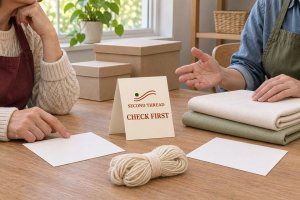
When customer work goes to a craft-service provider, the useful handoff is more than an attractive package. Keep the right service paperwork and material references associated with the right piece, and preserve the packaging the provider actually requires.
Which finishing form should stay with a stitched project?
Start with the provider's own instructions. The Needlepoint Clubhouse finishing page asks customers to print, complete and submit a finishing form with their canvas. It links different forms for general finishing, pillows, handbags, and belts or dog collars.
Use the form relevant to the actual project. A promotional card with the shop's name is not a substitute for the requested service record. Nor does placing several pieces in one attractive bag explain which requested finish belongs to each piece.
Before changing the presentation, compare the work with the provider's current submission instructions. Keep the original form readable and associated with the correct item in the way the provider requests. If the relationship is unclear, resolve that question before handing the work over.
The linked forms themselves were not reviewed for this article. Open the current relevant form and use its actual fields; do not reconstruct it from this summary.
Does “finisher's choice” mean my own preferences are recorded?
The same finishing FAQ describes this as letting the finisher select fabric and trim while welcoming customer input. It also says customers may provide their own fabric. These are different decisions from simply choosing a decorative outer package.
Keep requested options on the provider's appropriate paperwork rather than relying on a note on a shopping bag. If you have a specific preference, ask how the provider wants it documented. An organizer should not silently choose on someone else's behalf or treat a display sample as that customer's approved selection.
Why keep the original thread label or dye-lot reference?
The Needlepoint Clubhouse general FAQ says dye lots change with shipments and an exact match cannot be guaranteed. It invites customers to ask before ordering when trying to match thread already in their stash.
Keeping the available original reference can help explain what you are trying to match. It does not make a replacement an exact match or prove current stock. Retain the actual label information rather than replacing it with an invented color description.
For a group handoff, avoid mixing material references between projects. An orderly new package is less useful if the original information has become separated from the work. Follow the receiving provider's instructions for presenting references without attaching a new adhesive label directly to delicate work.
What if a service needs the material's actual name?
Seattle Pottery Supply's firing-service page requires customers to know the clay name. A project nickname or the color of a decorative bag does not answer that requirement.
Keep genuine material information available for the provider's assessment. If it is unknown, say so and ask the provider what it needs. Do not infer a technical specification from appearance or manufacture a label to make the intake seem complete.
Can a paper shopping bag replace the required protective package?
The pottery-service page asks customers to carefully box work with padding for drop-off. An ordinary paper shopping bag should not be described as an equivalent replacement.
Keep identification, presentation and protection as separate questions. A printed logo can identify the organizer; it does not establish suitability for fragile work. Preserve the provider's actual packing instructions and ask the provider about a particular piece when those instructions leave a question unanswered.
This article does not specify padding materials, load limits or a transport method. It also does not verify that any customer's existing package is adequate. Those decisions depend on the work and the receiving service's requirements.
A handoff review that preserves the original package
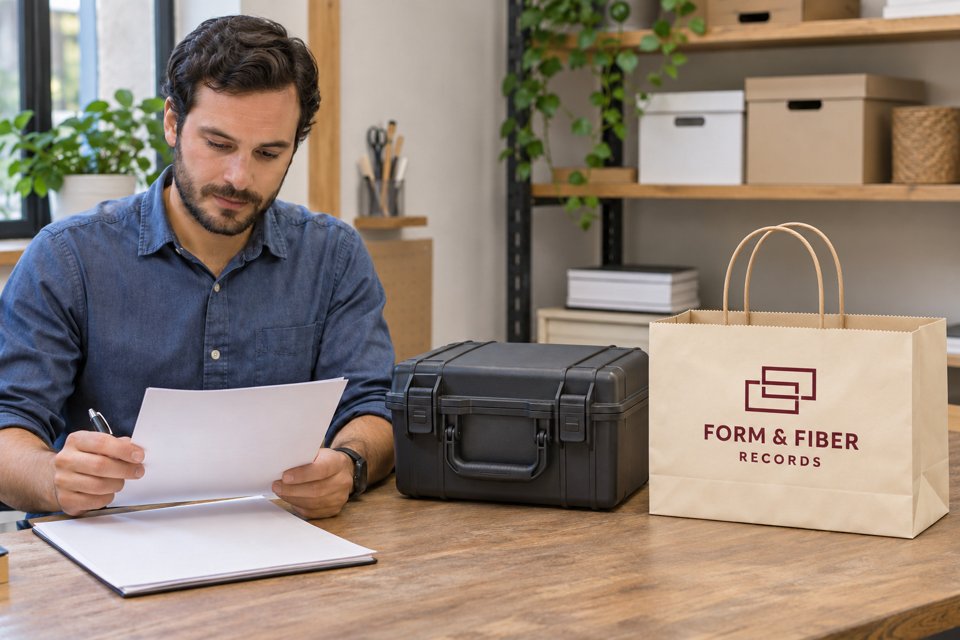
Fictional example: Form & Fiber's coordinator proposes moving customer craft work into matching printed paper bags for a neat collection-day presentation. The draft also separates the service paperwork from the individual packages.
The coordinator holds the proposal and checks the actual service instructions. The revised handoff plan keeps each work item in its required protective package and keeps its corresponding original service paperwork and available material references associated with it. Any unresolved intake detail is sent back to the customer and provider for clarification.
In this fictional review, the organizer approves the corrected plan using existing suitable document organization. The protective packaging is not replaced, and the extra branded bag order is closed without purchase. No actual customer handoff, provider approval or damage-prevention result was verified.
Optional presentation for ordinary paperwork
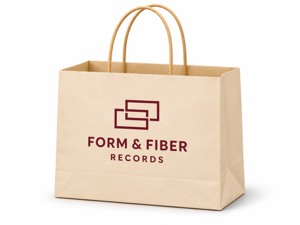
Matte paper shopping bag
If there is a separate confirmed need for paper bags for ordinary dry paperwork, this product lists matte paper, twisted kraft-paper handles and 16W × 12H × 6 inch dimensions. The current quantity control starts at 50.
Compare custom paper bags with existing suitable packaging before ordering. Bring original artwork and approved wording to DecentCustom for proof review. The illustrated bag is empty; no fragile-work protection, load capacity or water resistance is established here.
Reviewed November 20, 2026 using the three linked primary provider pages. The finishing page links project-specific forms; their contents were not reviewed or submitted. Guidance is editorial, the example and identity are fictional, and no actual service or product-performance outcome was verified.