Sales kickoff planning • Reviewed November 27, 2026
Build one sales kickoff practice block around a buyer decision. Leave with a revised question, an unresolved issue owner and a manager review date, rather than a notebook full of unassigned ideas.
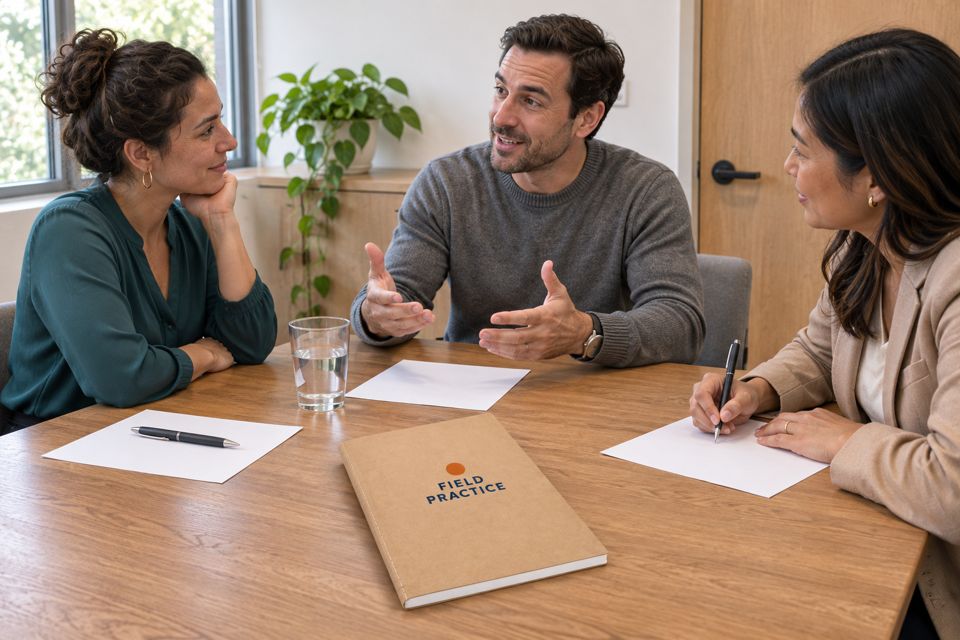
What should a sales kickoff agenda produce?
Choose something a participant can demonstrate: ask a useful discovery question, check a proposed answer against an approved source, and agree a suitable next step with a buyer. Name who reviews the attempt afterward. “Attend the kickoff” and “understand the strategy” do not tell a facilitator what to observe.
The example below is one 90-minute practice block for an adult business-to-business sales team. It is not a full-event schedule or a proven ideal session length. Reserve separate time for breaks, leadership updates and any other event commitments. Adapt or shorten the block to the actual team and access requirements.
Salesforce’s virtual sales kickoff guide, written in a 2021 planning context, describes setting goals, using role plays with feedback and reinforcing learning afterward. Its objection-handling template, page 12, gives a separate manager-led exercise using past conversation themes, practice and a debrief. These are operational examples from one vendor, not evidence that this agenda will improve revenue. The schedule and fictional case here are our own worked example.
Before the session, the manager chooses one relevant buyer problem from information the team is permitted to use. Remove identifying details or create a fictional case. The facilitator prepares an approved facts sheet and marks anything unresolved. Test access to the shared document and provide a usable alternative before participants arrive.
A 90-minute sales kickoff practice agenda
Illustrative schedule: three participants work together as seller, buyer and observer. Each tries every role. A manager or facilitator owns the session; an assigned subject owner handles questions the group cannot answer.
| Time | Activity | Visible output |
|---|---|---|
| 0–10 minutes | State the buyer task, boundaries and observation criteria. | One shared task and the current facts-sheet version. |
| 10–25 minutes | Read the fictional case, clarify roles and prepare questions. | One opening question per seller; unknowns stay marked unknown. |
| 25–50 minutes | Run three five-minute conversations, with two five-minute role changeovers. | Three observed attempts, each linked to its participant. |
| 50–70 minutes | Give each seller four minutes for specific feedback and a short retry; use the remaining eight minutes to revise notes. | One revised question or response per person. |
| 70–85 minutes | Resolve what can be resolved; assign the rest and book manager reviews. | Issue owners, review dates and the agreed evidence to bring. |
| 85–90 minutes | Read back the actions and explain where the current materials live. | A confirmed next step, including an explicit hold where needed. |
The six blocks total 90 minutes. This example gives each person five minutes as seller and a short retry; it does not provide 25 minutes of selling practice per participant. For more complex cases, reduce the number of objectives or plan another session rather than silently compressing feedback.
A fictional buyer case with a useful stopping point
Practice brief: a warehouse operations buyer is considering a workflow service. Night-shift staff need to report exceptions, but the buyer has not confirmed who will review those reports. The training facts sheet contains no approved answer about night-shift support hours or implementation timing. This is an invented scenario, not a description of a DecentCustom customer or software offering.
Buyer role
Ask: “Can we have this running next month?” If asked about the underlying need, explain that unresolved exceptions pass between shifts. You can discuss the problem, but you cannot approve a purchase without the operations lead.
Seller role
Clarify what “running” must include, who uses the process and who confirms readiness. Use only the supplied approved facts. Do not invent a delivery date, support promise, return on investment or customer success story.
Observer role
Write down the actual question asked, whether the seller distinguished a known fact from an unknown, and what next step the buyer agreed to. Observe the attempt rather than assigning a personality label.
A possible opening is: “Which exception needs to reach which person before the next shift starts?” A suitable provisional response is: “I cannot confirm that timing from our current information. May we map the required handoff with your operations lead and have our implementation owner check feasibility before we discuss a start date?”
That response still needs the buyer’s agreement. If the buyer is not ready, the team cannot support the requirement, or another solution already handles it adequately, a pause or no-fit decision is a valid outcome. The exercise is not a contest to force a yes.
Useful feedback sounds like: “You asked who would review the report, but promised next-month implementation before checking it. Retry that sentence with the timing unresolved.” “Be more confident” gives the seller no particular action to practice.
Turn session notes into a manager review
Close the loop in the team’s existing document or coaching process. Keep private practice notes separate from any approved customer record. Use real conversation material afterward only under the organization’s existing permissions and access rules; the session does not require recording customers.
Copyable follow-up record — fictional example
Practice task: clarify the shift handoff before discussing timing.
Observation: asked who reviews exceptions; initially guessed an implementation date.
Revision: state that timing is unconfirmed and identify the implementation owner.
Open question: can the required shift handoff be supported?
Owner: assigned implementation lead; no commitment released while pending.
Manager review: next agreed one-to-one, with the revised question and an approved response if available.
Review result: record what was demonstrated, what remains unresolved and the next action.
Keep attendance, completed practice, a manager review and an actual business outcome separate. A calendar invitation is not evidence that a review happened. A completed exercise is not proof of higher conversion. If the manager cannot review every participant, narrow the assignment and agree a feasible review schedule before promising follow-up.
Choose materials after choosing the exercise
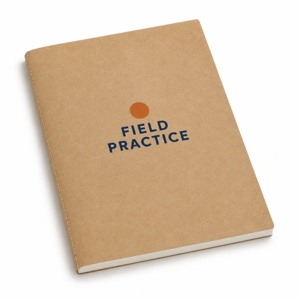
A notebook for private working notes
Existing paper or a shared digital template may be enough. If participants need a separate physical notebook, these A5 kraft-cover notebooks for private practice notes list 80 sheets, a kraft paper cover, compact stitching and blank pages by default. A pen is not included. The sample cover does not mean the exercise is printed inside.
Compare custom padfolio and notebook options against the actual writing task and existing supplies. Confirm the selected quantity, cover artwork and configuration with DecentCustom before ordering. Do not turn the attendance list directly into a purchase quantity.
Field Practice is fictional AI artwork. The image illustrates a possible cover concept, not a tested learning outcome, an included pen or a promise about custom interior pages.
Questions before finalizing the kickoff block
Does every sales kickoff need a 90-minute exercise?
No. This is a worked example for one task. Set the objective, participant needs and available time first, then adjust the scope and schedule.
Can remote colleagues use the same case?
Yes, if they can access the brief, join the role rotations and share feedback. Test the actual meeting and document access, and provide an alternative when needed.
What should happen to an unanswered product question?
Record the question, name its authorized owner and hold unsupported promises. Share an approved answer through the current materials when it is available.
Is a branded notebook necessary for the practice?
No. Existing paper, a suitable notebook or a digital document can hold the notes. Choose a new item only for an identified use.