Company holiday party planning • Reviewed November 27, 2026
Collecting a food request does not confirm a meal arrangement. Give each request a responsible venue contact, return the actual answer to the guest and keep unconfirmed claims off the party signage.
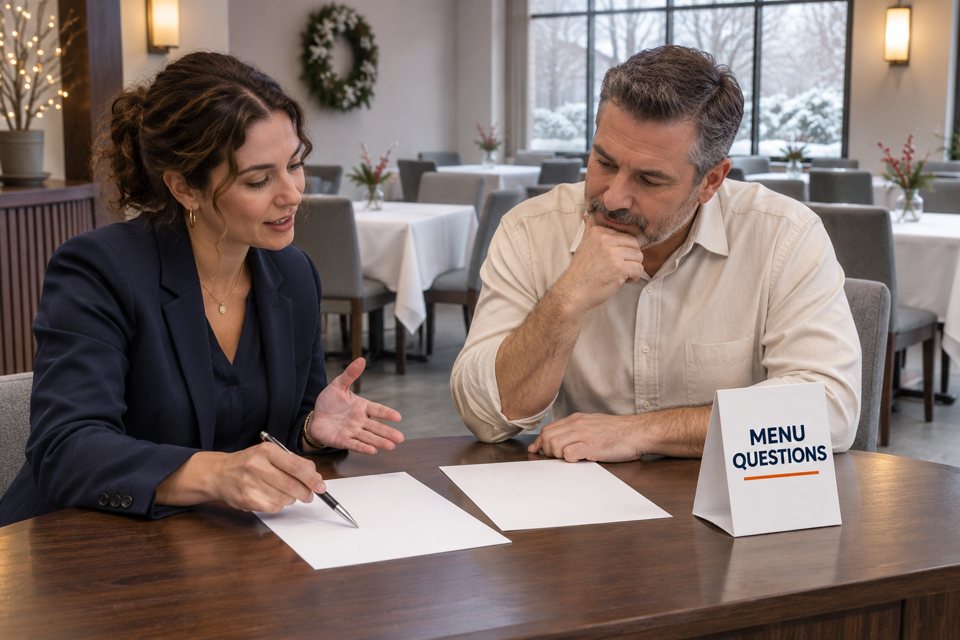
Separate a food request from a confirmed arrangement
A holiday party RSVP may tell you that someone wants to discuss a meal requirement. It does not tell you what the kitchen can provide, what information the guest still needs or whether the guest has heard the answer. Keep those tasks separate before anyone writes the menu card.
| State | What it establishes | What still needs an owner |
|---|---|---|
| Request received | The coordinator has received the guest’s question or request. | An agreed venue contact must review or arrange a direct discussion. |
| Venue response received | A named venue representative has answered a specific question. | Check the scope of that answer and return it to the guest. |
| Guest informed | The relevant answer or contact arrangement has reached the guest through the agreed channel. | Resolve any remaining questions and communicate changes. |
Even the third state does not certify that a meal is suitable or that a person can eat it. Record the particular communication completed, rather than replacing it with a broad “all dietary needs handled” checkbox.
The NCHPAD holiday party guide recommends asking about dietary needs ahead of time and explaining event arrangements. Food Allergy Canada’s catering guidance describes event managers working with the food and beverage manager or chef, and direct communication with guests. We use that communication principle here, not its full food-service procedures or a claim about US requirements.
Give the request a venue contact and a reply route
Before sending the RSVP, agree with the venue who receives food-related questions and who can answer them. A sales contact who books the room may need to involve the chef or another responsible manager. Establish the handoff rather than assuming any staff member can confirm ingredients or preparation.
The invitation can offer a private route for a guest to discuss a requirement. Explain who will receive the necessary information and how the venue will reply. Do not put individual food-allergy details beside names on a public seating list or ask for a medical history when the task is to arrange a conversation.
Preserve the guest’s meaning when passing a request through the agreed process. Do not silently turn an allergy question into a preference, combine several different requests into “special meal” or interpret an unanswered question yourself. Where detail or clarification is needed, connect the guest with the responsible venue person.
A useful coordinator question is: “Who will answer this guest’s menu question, when should they expect a reply, and how will the serving team know the arrangement if one is agreed?” Keep the venue’s actual response, its date and the relevant menu version with the working event record. Share it only with the people who need it for the task.
A callback can be arranged while the meal question stays open
Fictional worked example: an adult employee asks to speak with the venue about sesame before deciding on a party meal. The coordinator records an internal reference, M04, rather than adding the question to the shared table plan. This example contains no actual guest information.
M04 — first working record
Request: guest wants a direct discussion with the venue about sesame and the proposed meal.
Received by: event coordinator through the private reply channel.
Next owner: venue event manager, who will involve the chef.
Response due: the review time agreed with the venue.
Current status: request received; venue response pending.
Public wording: no claim about a suitable or allergen-free meal approved.
The venue manager replies that the chef can speak with the guest through a private callback. That resolves who will discuss the question. It does not answer the ingredient or preparation question. The coordinator updates the record precisely:
M04 — after the venue reply
Venue response: chef callback can be arranged through the event manager.
Guest informed: coordinator has sent the callback arrangement through the agreed private channel.
Still open: the guest’s meal question; direct discussion has not yet occurred.
Next check: coordinator confirms whether the connection happened and whether any event arrangements need updating.
A suitable reply is: “The venue event manager has offered to arrange a chef callback about your question. I have sent you that contact route privately. We have not yet confirmed a meal arrangement.” It is more accurate than “Your dietary request is all sorted.”
After the discussion, record only the event arrangement that the responsible people have actually agreed, including any limitations and remaining questions. The coordinator should not infer permission to serve a dish from a completed callback, a guest’s attendance reply or an attractive menu description.
Recheck the arrangement when the menu or contact changes
Tie any approved guest-facing information to the actual menu and service plan. If a dish, ingredient, supplier, serving arrangement or responsible contact changes, ask the venue which earlier answers are affected. Return the relevant updated information to the guest through the agreed route.
Do not independently remove an ingredient from a description and declare the dish suitable. Questions about ingredients, preparation and cross-contact belong with the responsible food-service team and the guest. A coordinator’s spreadsheet or printed symbol cannot verify those conditions.
Before the event starts, check that the named contact route is usable. Brief the host on who should receive a menu question; do not ask them to improvise an answer from memory. If the expected person is absent, obtain an actual replacement contact and correct the signage and event notes together.
This guide covers organizer communication, not medical advice, kitchen training or a food-safety assessment. It does not establish that any pictured venue or proposed meal can meet a particular guest’s needs.
Use a table card to find a person, not to promise a result
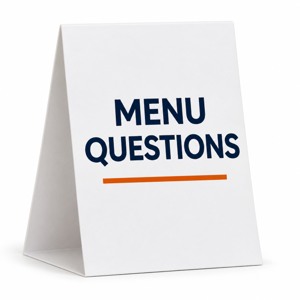
A dry information prompt at the host desk
If the venue has confirmed a staffed contact point, a short message might read: “Menu questions? Please speak with the venue event manager at the host desk.” Add only the actual agreed role and location. If there is no such arrangement, do not print it.
These paper table tents for an approved venue contact list a 5 × 7-inch size, 14pt stock and full-color printing. The folded paper format needs no separate stand. Check the actual-size proof and the selected finish; keep it in an appropriate dry location.
Compare custom marketing materials or use the venue’s existing suitable sign. Bring approved wording and artwork to DecentCustom only if a new printed item serves the event. The AI tent illustrates a contact prompt, not verified ingredient information, waterproof performance or an allergen-free guarantee.
Questions before approving party food information
Does collecting dietary requests confirm suitable meals?
No. Track the venue response and guest communication separately. Keep the actual meal question open until the responsible people resolve it.
Who should answer an ingredient or preparation question?
Use the venue’s responsible chef or manager through the agreed process. Do not have the event coordinator guess from a dish name or old menu.
Should personal food requests appear on shared event signs?
No. Use the agreed private channel for individual questions and necessary arrangements. General signs can explain how to reach the responsible venue contact.
Can the existing venue sign be enough?
Yes, if its wording and contact route match the actual arrangement. Another printed item is unnecessary when an existing one serves that job.