Choose poultry-shop staff clothing by the actual task, laundering process and rotation between washes. An ordinary reception Polo needs a role and care review before its logo or order quantity is approved. A garment’s minimum order and case pack do not tell you how many shirts the team needs.
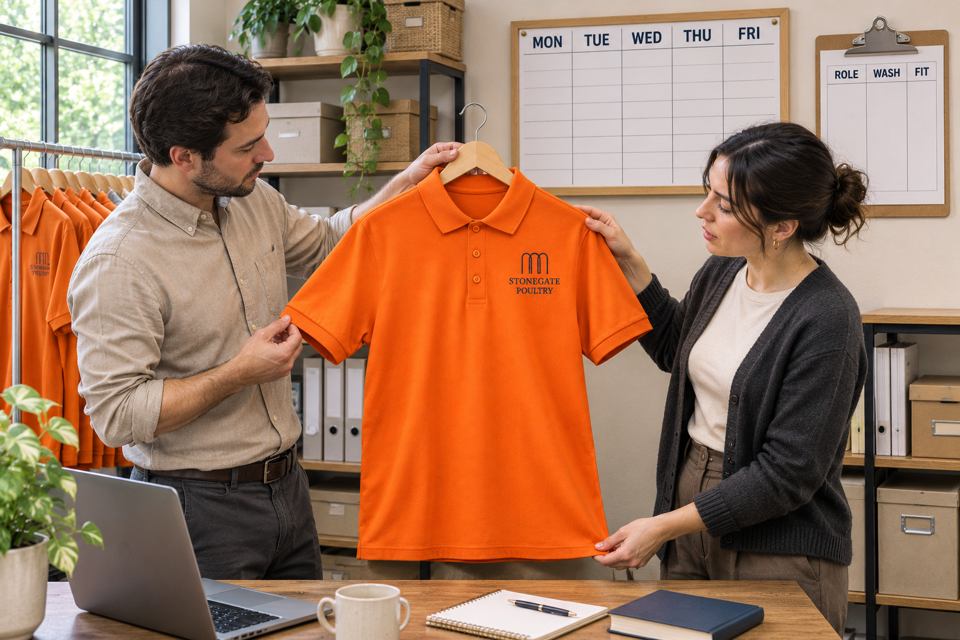
Describe the work before selecting a uniform
Harrison’s Poultry’s service page describes poultry prepared to customer specifications and pickup or local delivery. That shows different service activities at one operator; it does not reveal the actual staff clothing, laundering process or protective requirements for those jobs.
For your shop, separate ordinary reception duties from cutting, food preparation, cold-room work and any task with specific protective requirements. The person recording cut and wrapping requests is not necessarily the person performing the preparation. If one worker changes roles, review the requirements of the next task rather than assume the same shirt is sufficient.
Record the actual movements too: reaching for a file, working at the counter or moving supplies can affect fit and comfort. Ask the wearer to review the real task. A catalog’s general comfort description and a printed logo are not evidence of fit or protection.
Do not approve a wash process from an incomplete care note
Collect the actual wash temperature, unit, cleaning agents, drying method, turnaround and any requirements that apply to the chosen decoration. Confirm those details against the specific garment’s care information. Machine-washable does not establish compatibility with every commercial laundry process.
The Polo considered below illustrates a useful information gap. Its current product page tells buyers to wash below 30 degrees, but that note does not state the temperature unit. It also advises against bleach, prolonged soaking and dry cleaning. Obtain complete, unambiguous care instructions before treating the garment as compatible with the shop’s process.
A fictional compatibility decision
Stonegate Poultry’s reception team uses an external laundry arrangement specified at 60°C in this exercise. That is a fictional business requirement, not a recommended food-hygiene standard.
The buyer has not obtained care information confirming that the proposed Polo and its decoration can use that process. The unqualified 30-degree note does not establish 60°C compatibility. The selection stays on hold while the garment information is clarified or another suitable garment is reviewed.
The team does not lower an actual job or laundering requirement merely to make a preferred logo shirt appear suitable. It retains its existing appropriate clothing arrangement while the proposal is unresolved.
Count the garments needed before the next usable return
Stonegate, Jan, Eli and the schedule below are fictional. For this quantity exercise, the team chooses one clean reception shirt for each listed workday, with no rewashing during the week. Laundry leaves on Friday and is assumed to return usable before the next Monday. These are planning assumptions, not general hygiene rules or a verified laundry service.
A worked two-person rotation proposal
- Jan: reception on Monday, Tuesday and Wednesday: three planned shirt uses before the next return.
- Eli: reception on Tuesday and Thursday: two planned shirt uses before the next return.
- Chosen reserve: one additional shirt for Jan and one for Eli, in each person’s own approved size.
Under these assumptions, the proposal is Jan’s three plus one reserve, and Eli’s two plus one reserve: seven garments in total. That is four allocated to Jan and three to Eli, not seven interchangeable shirts in one size.
The count is provisional. If existing suitable shirts remain available for these uses, account for them before proposing new purchases. If the laundry returns later, someone works an extra day or the team chooses a different reserve, recalculate the affected person’s rotation. Do not simply add an arbitrary box of spares.
Even a correct rotation count does not resolve the care-compatibility hold. Seven is a worked planning result here, not an instruction to buy seven of the listed SKU.
A complete brief that lets the buyer resolve the gaps
Stonegate’s draft garment-review request
Hello,
We are reviewing ordinary clothing for two reception staff. This proposal does not cover cutting, food-preparation, cold-room or protective-clothing roles.
Our fictional weekly plan requires four shirts allocated to Jan and three to Eli, including one chosen reserve each, if no existing suitable garments cover those uses. The wearers’ final sizes and quantities are not approved yet. Please provide the current size chart and measurement guidance for the exact garment configuration.
We also need complete care instructions, including the temperature unit, washing and drying limits and any restrictions for the proposed decoration. Our exercise uses an external 60°C laundry specification. We have not established compatibility with SKU decentcustom-cl-000043 and will keep the selection on hold unless the actual garment and decoration information supports the required process.
Please distinguish documented care information from general comfort, fade-resistance or durability descriptions. We have not performed a fit, shrinkage or repeated-wash test.
If the role, fit and care requirements can be met, we will then confirm the actual allocation, color and logo arrangement and request the full configured price with applicable shipping and tax and the proposed delivery dates. This inquiry is not a purchase approval.
Thank you,
Stonegate reception-clothing coordinator
This is an illustrative draft, not a message actually sent to a supplier. Keep the role, wearer allocation, care decision and final configuration together so another buyer can see why the selection is approved, held or rejected.
What the current Polo listing establishes
Compare custom polo shirts after establishing the actual role and care requirements. Confirm the exact color, size, care and decoration configuration. If a suitable existing garment and name badge already meet the reception task, a new printed shirt may not be necessary.
Approve the garment before the artwork
Resolve the care-information gap, wearer fit and actual rotation before ordering. Keep the existing appropriate arrangement while a proposed shirt is on hold. When those decisions are settled, bring the specific role, sizes, quantities and approved logo brief to DecentCustom; the product minimum does not replace that planning.