Keep four questions separate in a poultry order: what is the item, how has it been prepared, what state is it supplied in, and is the order ready for collection? “Seasoned,” “frozen” and “ready for pickup” do not answer the same question. Check the actual product record and retain its supplied instructions.
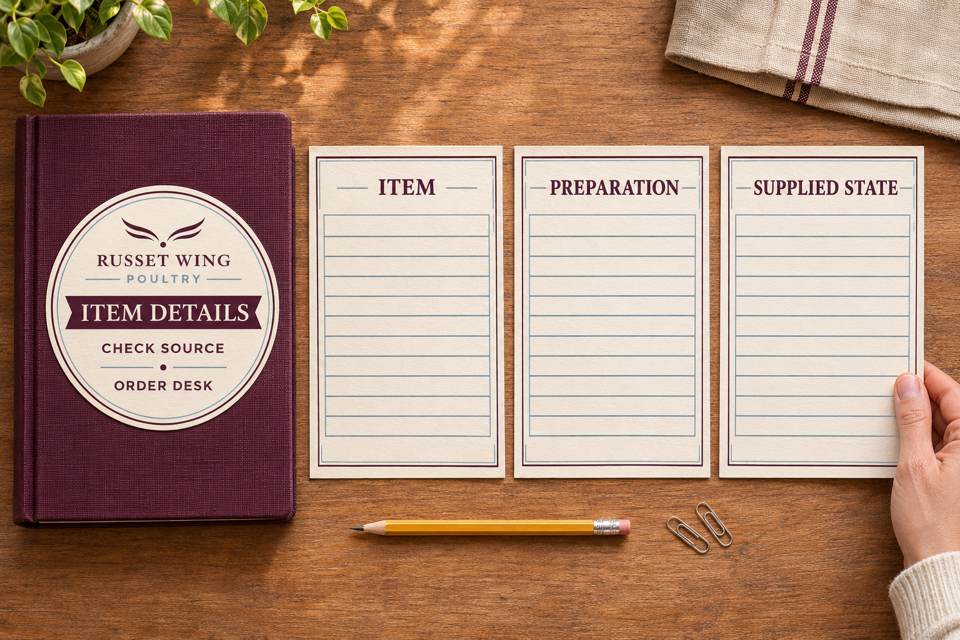
A frozen item can have a different preparation status from another frozen item
Harrison’s Poultry’s menu illustrates the distinction. Its Chicken Al Pastor description identifies the product as raw and points to the store’s freezers. A roasted half-duck listing identifies a different item as frozen and fully cooked. These are two item-specific descriptions from one operator, not a rule that every frozen poultry product has the same preparation status or current availability.
Appearance is not a dependable substitute for the record either. A CDC report on frozen stuffed chicken products explains that some raw breaded products can look cooked because of how their breading is set. That is a reason to read the actual product information, not to judge a product from a photograph.
Use the wording and instructions that belong to the actual item. A general description such as “prepared poultry” may refer to cutting, seasoning or other preparation without answering whether the item is raw or cooked. “Order ready” describes the collection process; it does not turn a raw product into food ready to eat.
Two worked records that keep the fields separate
Russet Wing Poultry, its staff and records P17 and P18 below are fictional. For this exercise, assume the responsible shop team has verified the stated item details against the actual product information. These examples are not real products, mandatory food-label templates or cooking instructions.
P17: seasoned chicken item
Item: the particular seasoned chicken product identified in this order’s item record.
Preparation status: raw, with seasoning already applied.
Supplied state: frozen, as confirmed for this item.
Collection status: not yet confirmed ready.
The seasoning description does not mean it is cooked. The frozen description does not establish a cooking method. The team keeps the original product and packaging information with the actual order instead of replacing it with this office summary.
P18: fully cooked duck item
Item: the particular duck product identified in this order’s item record.
Preparation status: fully cooked, as stated in the verified product information.
Supplied state: frozen, as confirmed for this item.
Collection status: not yet confirmed ready.
This is a different product record from P17. Its fully cooked description must not be copied across to the chicken item. The actual product’s supplied directions still govern its handling and preparation.
Both fictional items are supplied frozen, but their preparation descriptions differ. Neither record says the order is ready to collect. Keeping the fields distinct makes the unresolved collection status visible without obscuring the product information.
Do not approve a combined summary that changes the meaning
Suppose an order summary groups P17 and P18 under “two cooked frozen meals.” That summary conflicts with P17’s verified raw status. Lena, the order coordinator, holds the summary for correction and asks Omar, who maintains the item record, to check the exact items and wording.
Lena’s complete internal correction note
Hi Omar,
Please hold the combined summary for P17 and P18. The heading “two cooked frozen meals” is not supported by the records we checked. P17 is recorded as a raw seasoned chicken item; P18 is recorded as a fully cooked duck item. Both are supplied frozen in this example.
Please verify the current item references and return a corrected summary that keeps the preparation status attached to each product. Do not copy P18’s cooked description to P17 or use a general “prepared” heading to conceal the difference.
The collection status is still pending separately. Once the product information is corrected, the counter team must complete its actual readiness check before sending a pickup notice. Keep the original product labels and instructions with the order.
Thank you,
Lena, Russet Wing order desk
The correction concerns the meaning of the combined wording, not just its spelling. If the underlying records disagree, the team must resolve that discrepancy rather than make the summary look consistent by guessing.
A complete reply when a customer asks what “prepared” means
Customer clarification after the item records are checked
Hi Jamie,
Thanks for checking the word “prepared.” For the two items in this fictional order, the seasoned chicken item P17 is raw and supplied frozen. The duck item P18 is described in its verified product information as fully cooked and supplied frozen. They should not both be described as cooked meals.
Please retain and follow the actual product and packaging instructions supplied with each item. This order message does not replace those directions or provide a different cooking or storage method.
We have not yet confirmed that your order is ready for collection. We will send the agreed collection details after the counter team has completed the readiness check. If an item description or supplied instruction is missing or inconsistent, please contact us through this order conversation so we can resolve the specific item before the handoff.
Thank you,
Lena, Russet Wing order desk
This fictional reply assumes the raw/cooked and supplied-state details have actually been checked. If they are still unknown in a real order, ask the responsible team to resolve them first. A familiar menu name or an AI picture cannot fill the gap.
Keep the corrected information connected to the actual order
Omar maintains the item information; Lena checks the order summary and customer message in this scenario. At handoff, they identify the current item references, the corrected description and the separate collection status. The person sending the ready message uses the actual completed-order check.
Use the separate poultry cut and wrapping choices guide when a customer changes how a bird should be prepared or grouped. Such a request needs an answer; it does not automatically change the verified supplied state or authorize a substitute product.
An office identifier helps find the reference; it does not verify the food
Compare paper label formats only when an office identifier is useful. An existing index or handwritten binder title may already solve that problem. A label reading “check source” is a reminder to do the review, not proof that the review has happened.
Finish the record before printing the identifier
Check the actual item, preparation, supplied state and collection status separately. Keep unresolved details with the responsible person. If a repeatable dry-office identifier still adds value, bring its approved wording, surface, size and justified quantity to DecentCustom.