A recipe’s serving count is useful only with its portion size. Before planning a group demonstration, separate the number of visitors from the amount you intend to prepare and actually serve.
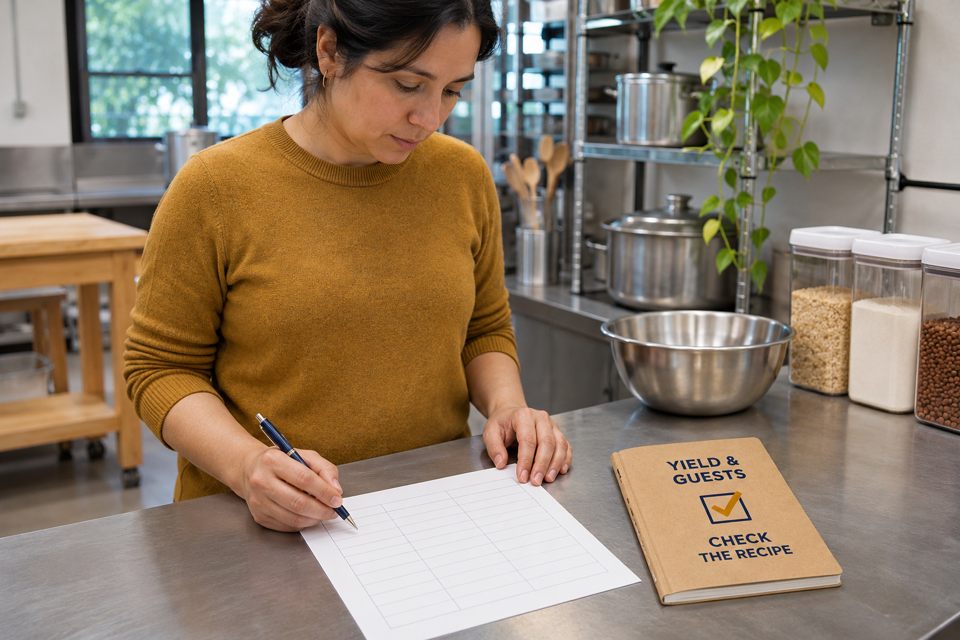
“Serves 16” needs the size of each serving
Attendance, recipe yield and planned portions are different inputs. Twenty-four people at a demonstration do not automatically mean 24 full recipe servings. Decide what the actual food activity offers before calculating a quantity.
For a concrete source, Washington State University’s Expanded Food & Nutrition Education Program publishes a Colorful Black Bean Salad recipe marked as 16 servings of half a cup each. That pairing gives a planning basis: the published yield represents eight cups in total.
A smaller tasting portion would be a different plan, not the same serving count under a new name. Record the portion you actually intend to offer. Do not choose it simply to make a batch appear to cover a larger audience.
A 24-portion example produces a 1.5 quantity factor
The following is an arithmetic planning exercise, not a tested larger batch or a recommendation to serve this food at a particular event. Suppose the host plans 24 portions, each half a cup, using the published 16-portion basis:
Published basis: 16 × ½ cup = 8 cups.
Planned amount: 24 × ½ cup = 12 cups.
Quantity factor: 24 ÷ 16 = 1.5, also 12 ÷ 8 = 1.5.
The source recipe lists one tablespoon of vegetable oil. Applying that factor gives 1.5 tablespoons on paper. It does not establish that a larger batch has been tested with your equipment or will produce exactly 24 portions in practice.
The source also lists a ten-minute preparation time. Treat that as information accompanying the original recipe, not as a confirmed time for a larger demonstration, room setup, portioning or service.
A can’s purchase weight is not the same as drained food
The WSU recipe calls for draining and rinsing the beans and corn, while its tomatoes and chiles are not drained. Retain those preparation states when making a shopping and preparation note. The weight printed on an unopened can does not, by itself, establish how much drained ingredient your operation will obtain.
The USDA Food Buying Guide for Child Nutrition Programs explains the distinction between purchase units, prepared forms and yield. It describes its yield figures as averages and identifies equipment, preparation method and serving utensils among factors that affect yield. That guide serves specific child nutrition programs; citing it here does not establish meal-program crediting or approval for a community activity.
Keep a calculated ingredient requirement separate from the number of whole packages to buy. If a required prepared amount is known but the actual package yield is not, that purchase conversion is still unresolved. Do not fill the gap with a guessed drained weight.
A planning note should say what has and has not been verified
For the exercise above, a complete note could read:
The person preparing food needs the complete current recipe and its handling instructions, not just this abbreviated calculation. Keep the selected recipe version, planned portion, ingredient forms and actual test notes together. If the host changes an ingredient, method or serving utensil, review the affected assumptions before printing a final quantity promise.
For the campaign context, see our current nutrition-month dates and official resources. The calendar provides a reason to plan an activity; it does not establish that a local kitchen or food-service arrangement is ready.
A notebook can hold the plan and test notes
Use an existing log or digital document if it already keeps this information clear. For a group with a genuine need for matching paper logs, kraft-cover A5 notebooks for a recipe planning log are one option. The linked SKU currently lists blank pages, 80 sheets and an 8.26 × 5.83-inch format. Its minimum is 12; the 500-piece case pack is separate. A pen is not included.
Compare custom padfolios and notebooks and confirm the actual format and artwork with DecentCustom. The notebook stores notes; it is not a measuring instrument, a tested recipe or food-service certification.