For a National Craft Month group, separate four questions before preparing a handout: may participants access the pattern, may you distribute copies, may you reuse its photographs, and what terms apply to finished items? Finding a free download answers the price question, without settling every intended use.
Can I print a free pattern for the whole group?
Check the actual pattern's copying and distribution terms before making a stack of handouts. Individual access and your own redistribution are different actions. A practical alternative is an original invitation that directs participants to the publisher's pattern page, where they can read the applicable terms themselves.
Lion Brand's terms reserve rights in its pattern content and restrict copying or distribution without the stated consent. That is a named publisher's policy, rather than a claim that every designer uses identical terms.
Record the original page, credited designer, terms you found and intended use. If the permission only covers personal access, do not silently expand it to group copies, a public download folder or a printed booklet. Keep the proposed copying unresolved until you have a sound basis for that use.
Can I use the publisher's photograph on an invitation or sales page?
A photograph needs its own check. Lion Brand's finished-item FAQ says website images may not be reproduced to sell finished items without written permission and directs makers to take their own photographs.
Do not treat access to instructions as permission to lift a styled product image. An image credit identifies a source; it does not by itself document the permission needed for a particular use. For an event invitation, choose your own appropriate original artwork or a photo you are entitled to use, rather than assuming a sales-photo rule grants event use.
Also distinguish a maker's own finished-project photo from the publisher's photo. They are different files, even when they show the same kind of project.
Can I sell finished items made from a free pattern?
Read the specific terms instead of relying on a general answer. Lion Brand's FAQ and terms require explicit permission for commercial use of items made from its patterns. Its free-pattern blog FAQ, however, gives a broader answer about finished-item sales while also telling readers to check permission.
Those pages do not provide a clear blanket approval for your proposed sale. Keep the conflict visible in your working notes and seek clarification of the applicable pattern and intended use before building a commercial plan around it. Do not present a broad blog summary as a substitute for that clarification.
The support FAQ also distinguishes patterns credited to other rights holders. A pattern hosted by one retailer may carry another designer's terms. This article reports the published wording; it does not decide a particular maker's legal rights or the enforceability of a term.
Does using only a small percentage make copying acceptable?
The U.S. Copyright Office's fair-use FAQ explains that there is no fixed word count or percentage that establishes fair use. The circumstances matter, and a particular use cannot be settled by a simple numerical shortcut.
Do not write “we changed a few lines” or “we used less than ten percent” as an automatic clearance for a group handout. Identify what you want to use and the basis for that use. Where a specific legal assessment is needed, take that question to qualified counsel rather than treating this planning article as a ruling.
A copied handout replaced with an original invitation
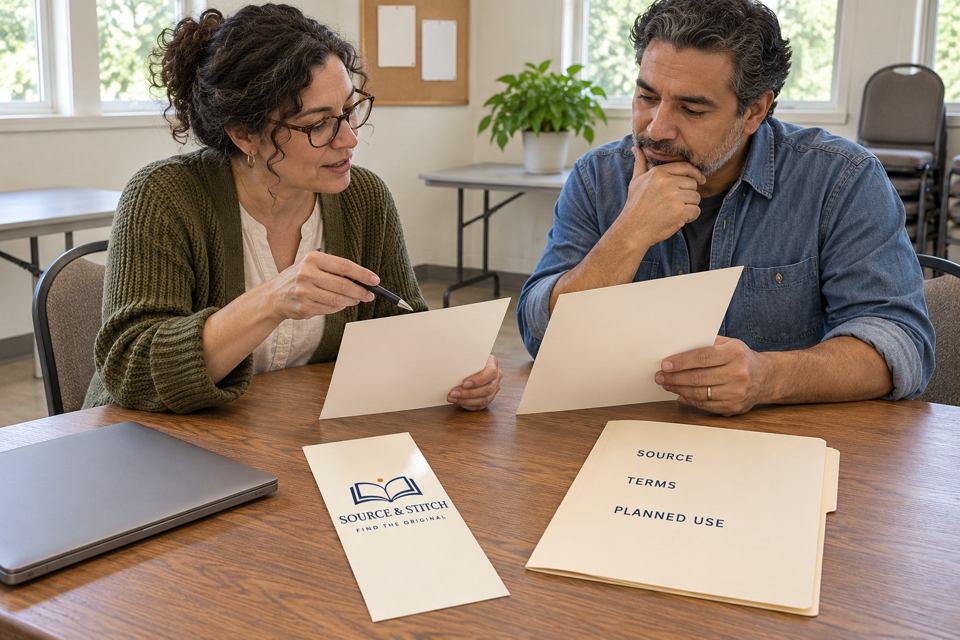
Fictional example: Source & Stitch drafts a March handout containing a downloaded pattern and the publisher's project photograph. The organizer notices that “free” was the only permission recorded.
The organizer removes both copied elements from the proposed handout. The group approves an existing digital invitation containing its own event wording and a link to the original pattern page. Participants can review the publisher's access and use conditions there. A separate idea to sell finished items remains unapproved while its terms are unresolved.
The copied booklet is withdrawn from the proposed print purchase, and no new order is placed. The completed fictional decision changes what the group shares; it does not claim that a real publisher granted permission or that any particular copying qualifies as fair use.
Print original group information when there is a real need
An original invitation, separate from the pattern
If approved event details need a paper summary, rack cards for your own group information list a 3.74 × 8.27 inch size, default 14pt stock and glossy front. The current quantity control starts at 50.
Compare custom rack cards with an existing accurate notice. Review original artwork and approved text with DecentCustom. Printing a card does not grant rights to a pattern, image or logo.
Reviewed November 20, 2026 against the linked U.S. Copyright Office FAQ and Lion Brand pages, including the difference in their finished-item wording. No permission request or individual legal assessment was performed. Source & Stitch and its decision are fictional.