Count what the activity actually uses before turning a registration total into an order. Separate per-person materials from shared tools, check usable stock, and record what remains after the event.
Registrations, participants and supply units are different counts
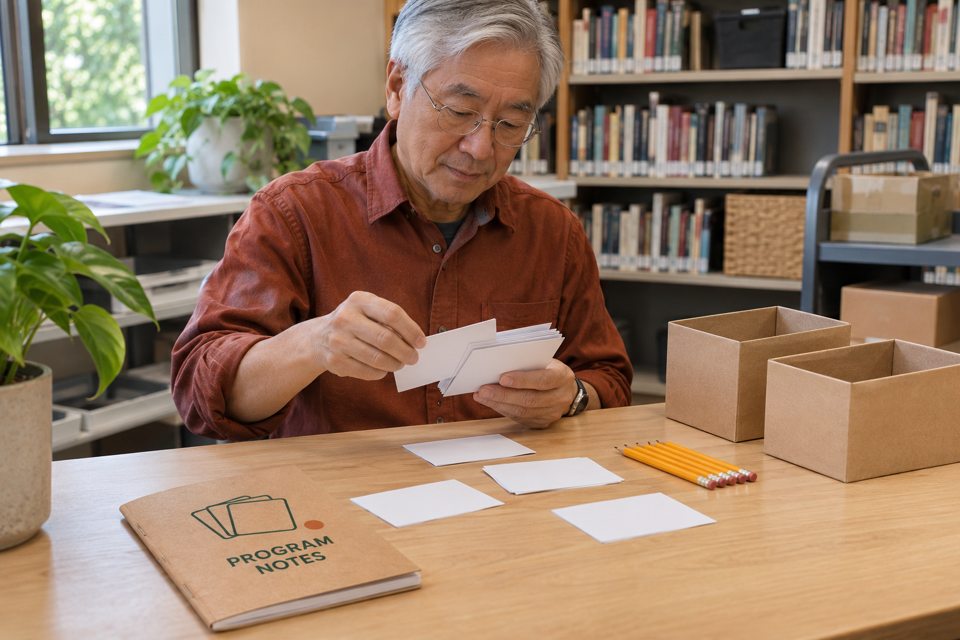
A National Library Week event might need one activity card per participant, two demonstration cards for the facilitator, and pencils shared at tables. Ordering every item at the registration count would mix three different needs.
First separate library event registration and seat confirmation. Then identify what the activity consumes, what it shares, and what staff need for setup. A confirmed registration is not a record of attendance or material use.
Abby Johnson's 2015 ALSC account of reconsidering registration describes programs filling on paper, followed by no-shows and leftover supplies. It is one librarian's historical experience, not a current attendance rate to apply to your event. Do not use it to halve an order or remove a required booking process. It does show why actual use deserves its own record.
Plan against the attendance and activity arrangements your event owner has approved. If turnout is uncertain, document that uncertainty and the replenishment options. Do not quietly replace the approved plan with an unsupported forecast.
Count stock that can actually be used for this activity
For each item, record its unit, planned use, usable quantity, other commitments and storage location. Six loose cards and six sealed packs are not equivalent. A box in another room is not available merely because someone remembers seeing it.
Inspect existing materials for the actual task. Separate damaged pieces, incomplete sets, obsolete dated print and items reserved for another session. Keep the reason for any exclusion beside the count so the next person does not add those items back by mistake.
A transfer from another branch should include a confirmed quantity, an owner and an arrival arrangement that fits the activity. If that transfer is still only a request, keep it outside available stock. A spreadsheet, reusable binder or existing inventory system can hold this information without buying another organizer.
A worked example: 14 cards to add, not 24
The following numbers are entirely fictional. A coordinator plans a reading discussion for 20 participants. The chosen plan also allows two demonstration cards and two spare cards. That reserve is an assumption for this example, not a recommended percentage.
Cards needed for the chosen plan: 20 participant cards + 2 demonstration cards + 2 spare cards = 24 cards.
Confirmed available: 6 usable cards already on the shelf + 4 cards in a confirmed transfer = 10 cards.
Additional cards needed: max(0, 24 − 6 − 4) = 14 cards.
Shared pencils: 4 tables × 2 pencils per table = 8 pencils needed at once. With 6 usable pencils already available, the gap is max(0, 8 − 6) = 2 pencils.
The coordinator does not order 24 new cards or 20 new pencils. The requirement is different for each item. If the four-card transfer is not confirmed, the card gap becomes 18 instead of 14; the uncertainty changes the procurement note.
A complete internal handoff could read:
A calculated gap is not yet an approved purchase. Check pack quantities, the current quote, delivery or preparation timing, and the event owner's purchasing process. If the item is sold in packs, record both the number of packs and the number of individual units they provide.
Leave the next coordinator a usable closing count
After the fictional session, suppose 18 people attended and each used one card; the facilitator used the two demonstration cards. That is 20 cards used, leaving 24 − 20 = 4 cards. Record those four as usable stock only after checking their condition and whether their content can be reused. Record missing or damaged pencils separately from the shared-tool starting count.
Keep actual attendance, materials used and materials remaining in separate fields. Add a short explanation of what changed, such as fewer participants or an extra demonstration. The example is a reconciliation of one event, not a forecast for the next one.
In Programming Librarian's 2026 financial-practice article, practitioners discuss tracking program purchases and costs alongside attendance. They also note that attendance numbers do not tell the whole story of a program's value. Use the count to explain the materials decision; assess the event's purpose separately.
Use the recording method your team can keep current
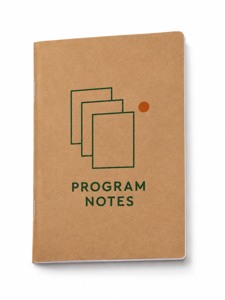
Keep an existing shared sheet or binder if it works. For a separate need to make portable handwritten notes during setup, consider blank kraft notebooks for portable program notes. The linked A5 notebook lists 80 blank sheets, measures 8.26 × 5.83 inches, and currently has a minimum of 12. A pen is not included.
The Program Notes image is an AI design concept, not a tested inventory system or a supplied worksheet. Its cover does not calculate quantities or replace the shared final record. Compare custom padfolios and notebooks and discuss approved artwork with DecentCustom only if that separate need remains. The worked card and pencil gaps are not a notebook order recommendation.