Employee family day materials • Reviewed November 27, 2026
A family day activity bag needs a defined job: carrying a household’s papers, holding one person’s materials or returning shared supplies. Count those jobs separately before choosing a bag or ordering more.
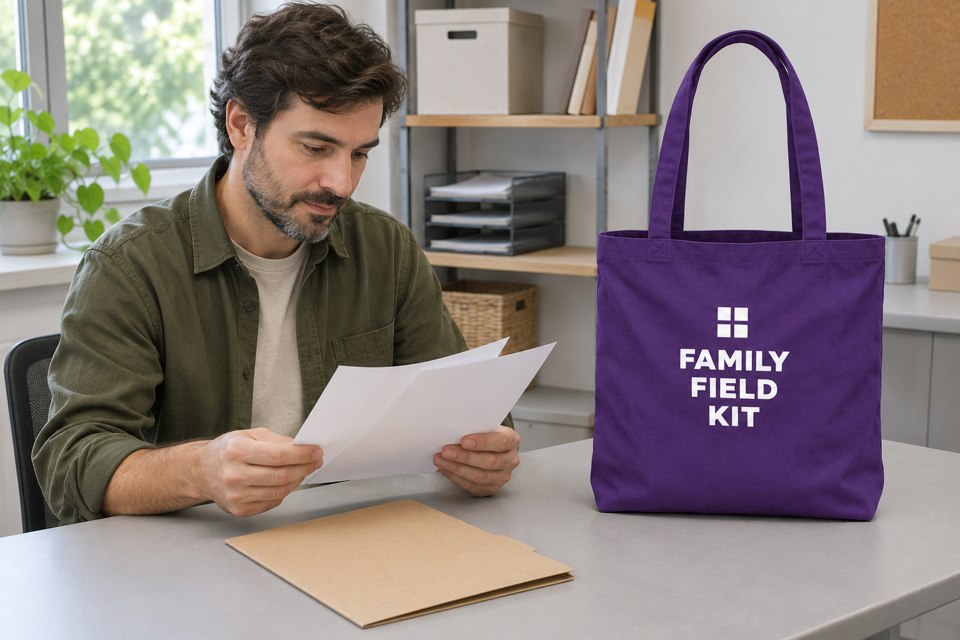
What should a family day activity bag actually contain?
Start with the confirmed activity, not a shopping list. A household carrying an agenda and a few completed paper activities may need one simple container. A participant doing an individual project may need a separate materials pack. Equipment shared at a table can stay at the table and return to its owner.
Keep take-home items and borrowed items on different lists. A welcome bag is easily understood as something guests can keep; placing a shared tool inside it without explanation creates an avoidable return problem.
The George Washington University’s 2026 workplace-visit toolkit lists goodie bags as optional and separately asks departments to prepare an activities agenda. That is a useful distinction: the activity needs its actual materials; an additional giveaway bag is a separate choice. Its programme and suggested contents are not a requirement for your employer’s event.
Make a contents list with a counting unit
For each item, write what it is for, who uses it, how many are needed and whether it leaves with the household. Do not use “one kit per attendee” until everyone agrees what a kit contains.
| Item in a fictional paper-activity plan | Counting unit | Owner or destination |
|---|---|---|
| Agenda and take-home papers | One set per registered household | Household keeps them |
| Individual activity sheet | One per participating person who needs it | Participant keeps the completed sheet |
| Shared clipboard | One per working table | Returns to the office supplies owner |
| Carry bag or folder | One per household choosing that carry option | Confirmed before distribution |
Ask the activity provider what is already included before adding purchases. Our guide to check event inclusions before buying extra supplies explains why a project kit, an arrival gift and event admission are different things. Apply that check to your own provider’s current arrangement.
If children participate, the organizer and activity provider must select appropriate materials and communicate their actual use arrangements. A logo or the words “family kit” do not establish a product’s suitability for children. This packing guide does not certify activity materials.
Check one complete pack before preparing the rest
Gather the actual papers and containers you plan to use. Put the full contents into one sample, including any folder that must remain flat. Check whether the opening allows easy loading, whether papers protrude or bend, whether the handles can be held comfortably by the intended adult and whether anything catches on an exposed edge.
Remove the contents again and compare them with the list. Ask a colleague who did not assemble the sample to identify what is take-home and what stays at the table. If that is unclear, change the instruction or distribution arrangement before packing the batch.
A product’s outside dimensions are a starting point, not a guarantee of usable internal fit. Soft fabric, seams, the opening and the actual contents affect the result. If the sample is unavailable, keep fit pending and confirm a suitable sample or measurement route before committing to a configuration.
A six-bag gap does not justify a hundred-bag order
Fictional worked example: an office coordinator has 24 households requesting a carry option. The supply owner identifies 18 existing bags available for those households to keep. That leaves 24 − 18 = 6 containers to resolve.
The coordinator compares a new tote whose current starting quantity is 100. Ordering 100 solely to fill six places would leave 100 − 6 = 94 new bags without an assigned use. A lower unit price at a larger quantity would not answer what those 94 bags are for.
In this fictional plan, the remaining contents are dry paper, and six existing plain folders are available. After checking the actual papers and asking the distribution team to explain the two carry options consistently, the coordinator uses 18 existing bags and six folders. No new tote order is placed.
The record also lists 30 individual activity sheets and four shared clipboards. Those quantities serve different units and do not change merely because there are 24 households. The clipboards stay at the four working tables and return to the supply owner.
This is an arithmetic and workflow example, not measured savings or a recommendation that folders suit every activity. Your actual registered groups, available inventory and pack contents determine the decision. For the earlier count, see our family day invitation and RSVP counts guide.
Make distribution and returns understandable
Give the packing team a short approved list rather than a photograph alone. Record the contents version, quantities prepared, items still missing and the person who checked the sample. Keep unapproved extras apart so they are not added differently to different packs.
At distribution, explain who receives the carry option and which supplies remain at the activity table. Reconcile issued containers and remaining stock afterward. Return borrowed equipment to its named owner and record any unresolved item; do not silently count it as available for the next event.
If the contents change after the sample check, repeat the relevant fit and quantity checks. Adding a bulky object to an already approved paper pack changes the job.
Consider a cotton tote when the quantity and contents fit
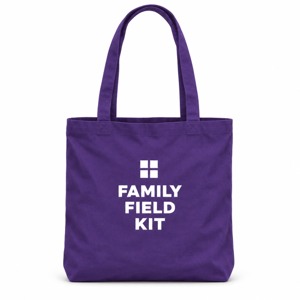
An optional adult-held carry bag
This gusseted cotton tote for adult-held event materials lists a 15-inch width, 16-inch height, 3-inch depth and 28-inch handles. The current quantity control starts at 100. Confirm the actual selected configuration and complete pack before ordering.
Compare custom bags and totes against existing supplies. Bring approved artwork and actual requirements to DecentCustom. The illustrated purple tote is an AI design concept, not a physical sample, a children’s product certification or a carrying-load test.
Ordinary cotton is not offered here as waterproof packaging, a protective case or a container for loose food. The example above closes the purchase without a new order.
Questions before packing
Does every attendee need a separate bag?
Only if the actual activity or distribution plan needs one. Household carry containers, individual materials and table supplies can use different counting units.
Can shared supplies go in the take-home bag?
Keep them separate unless the distribution and return arrangement is explicit. In the worked example, shared clipboards stay at the tables.
Will a bag with the right outside measurements fit our pack?
Check the actual complete pack and opening. Outside measurements alone do not verify internal fit, seam clearance or comfortable carrying.
What if the order minimum is much larger than the gap?
Compare existing containers, an appropriate alternative or no new bag. Assign a real use to excess units before treating a larger order as justified.