A helpful person at the desk is not automatically the instructor, storage owner or person authorized to move unfinished work. Map the question to the responsible role before adding printed materials.
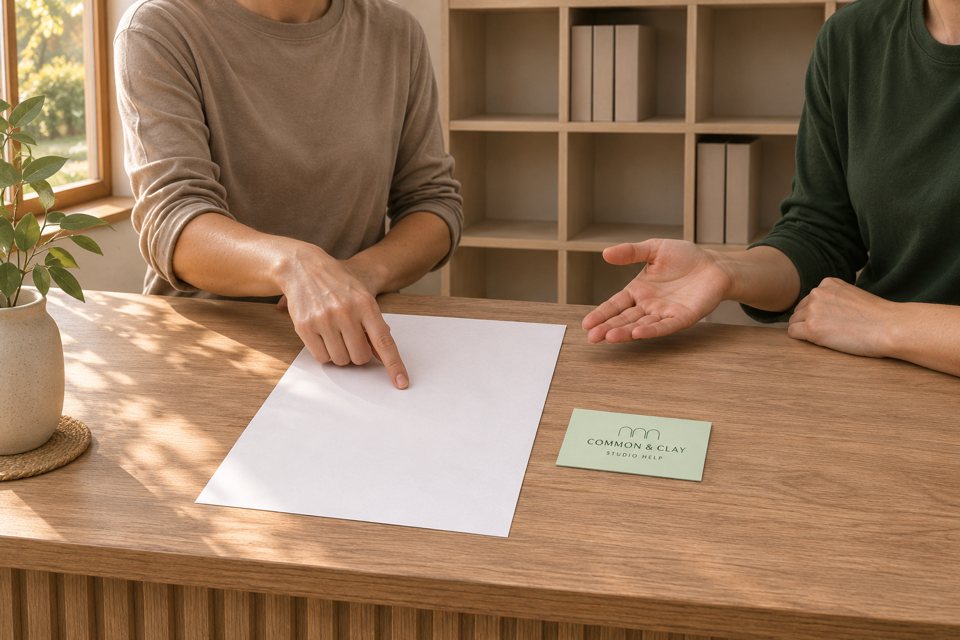
Map questions before assigning visible roles
A creative studio can have teaching, reception and shared-workspace responsibilities without assigning all three to the same person. Start with the questions people actually bring to the desk. Then ask the operator who owns each answer, what record they use and what happens when that person is unavailable.
| Question | Identify the responsible role | Check before replying |
|---|---|---|
| Which session did I book? | Booking or reception contact | Actual booking record and current session details |
| Can someone teach me this? | Instructor or program coordinator | Available instruction and appropriate support route |
| Where may I keep this project? | Person managing storage assignments | Assigned space and the operator’s current conditions |
| May this item be moved? | Work owner and designated studio contact | Ownership, permission and the agreed next step |
This is a suggested question map, not a staffing model. One person may hold several responsibilities in a small studio. Write down which responsibility they are answering under rather than inventing a separate job or assuming every volunteer can make the same decisions.
Seattle REconomy’s woodshop information gives a useful contrast. Its supervised Open Hours have a Woodshop Steward present. The page distinguishes machine-based guidance from more extensive hands-on support, for which it asks users to submit a request so suitable support can be matched. A general greeting at a desk therefore should not promise whatever instruction a visitor wants.
Separate personal assignments from shared space
Before designing a shelf notice, distinguish personally assigned storage, shared working space and items whose ownership or permission is unresolved. A place that looks empty is not enough evidence that a new participant may use it. A familiar logo on a card also says nothing about who owns an unfinished object.
Pottery Northwest’s membership page provides a named example of an assignment process: new members must complete orientation before receiving a shelf assignment and building access. It also describes independent members using areas that are not occupied by a scheduled class. These are that provider’s arrangements, not a general right to use any studio shelf or teaching space.
Keep the actual storage record with the operator. Ask where an uncertain item should be reported, who may check its owner and who can authorize a change. Do not print private member details or building access information on a general handout. This article does not set handling, disposal or technical storage rules for artwork and materials.
Make an unanswered question a clear handoff
A useful reception answer can be “I will route this to the person responsible” when the status is unknown. It should also identify the established contact route and explain what remains unresolved. Avoid turning a forwarded question into a confirmed lesson, shelf assignment or permission to move work.
For an internal handoff, the studio can record the question, relevant booking or project reference, responsible contact, unresolved point and next update. Keep that information in the existing staff process. Public information needs only the approved route and a plain description of the questions it handles.
Check the current route before producing anything new. An existing staff directory, orientation message or member account may already answer the question. Repeated confusion can justify improving that wording first; it does not by itself establish demand for new branded materials.
Resolve one uncertain shelf item without guessing
Fictional planning example: Common & Clay is preparing a beginner session. A reception helper sees an object on a shelf and assumes the space can be cleared for incoming participants. The helper recognizes the studio name on a nearby paper card but cannot identify the object’s owner or the shelf assignment.
The coordinator stops the proposed move and checks the studio’s existing assignment record. In this invented situation, the shelf belongs to an independent member. The coordinator contacts the designated storage lead through the internal route; reception does not treat the coming class or the printed card as permission to relocate the work.
The storage lead confirms the assignment and identifies a different space already approved for the beginner session. The object stays where it is. Reception updates its internal class-preparation note and directs future storage questions to the designated lead. These are invented planning outcomes, not evidence of an actual incident prevented or a universal studio procedure.
The team retains its existing orientation instructions. It considers a small public help card only for a stable contact route that visitors repeatedly need. Changing shelf assignments and individual project questions remain in the internal process.
Keep a public help card within its role
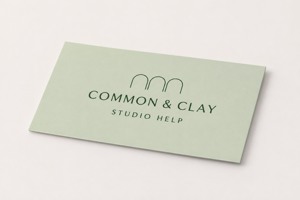
Ordinary paper for a dry reception desk
These custom business cards for a studio help route list a 3.5 × 2 inch format, default 14pt glossy stock, standard square corners and a current minimum quantity of 50. The artwork is an AI concept, not a tested shelf label or staff identification system.
Compare custom business cards only after confirming the actual distribution need. Review approved public wording with DecentCustom. A printed route does not grant access, establish skills, protect work from damage or replace the studio’s assignment record.
Provider pages and the linked SKU reviewed November 15, 2026. Named examples apply to their own services. Common & Clay, the responsibility map and the shelf scenario are editorial illustrations; actual staffing, permissions, safety, storage conditions and business results were not verified.