Clear a desk by giving each item an approved next step. A cleaner surface does not authorize anyone to discard records, relocate a colleague’s belongings or replace the office’s information-handling process.
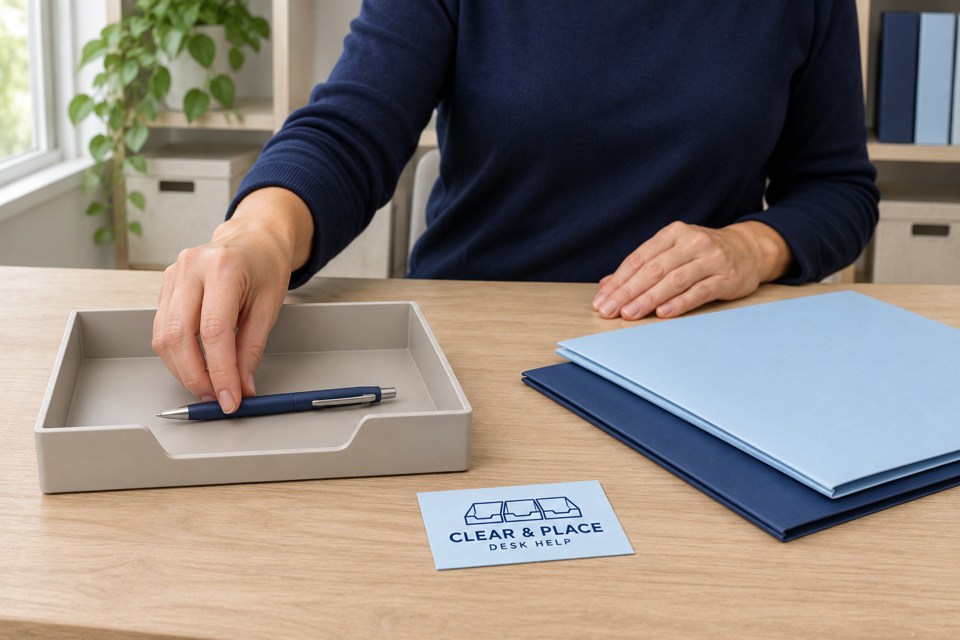
Set a desk-reset task before choosing a campaign date
Timeanddate’s unofficial holiday calendar lists Clean Off Your Desk Day on Monday, January 11, 2027, following the second-Monday-in-January pattern. This is a theme reference, not a confirmed office event or permission to remove anything from a workspace.
Define whose desk is involved, who may handle its contents and which work must remain available. Ask the person responsible for workplace records about the current handling and retention process before the session. Schedule the activity around real work; do not treat an attractive before-and-after photograph as its main completion test.
UC Santa Barbara’s privacy guidance pairs clean-desk practices, including securing documents in locked cabinets, with following its university records-retention policies and schedule. This is a useful institutional example of why clearing a surface and deciding a record’s future are separate tasks. Its policies are not automatically your organization’s policies.
Give each item a next step without guessing
Use the office’s existing locations and responsible contacts. The following suggested sorting questions do not set a retention period or authorize destruction.
| Item status | Next question | Before calling it resolved |
|---|---|---|
| Your active work | Where must it remain available? | Confirm the approved working or storage location |
| Known shared supplies | Does the office have an approved return point? | Confirm condition, ownership and return arrangement |
| Material proposed for disposal | Who can decide under the current process? | Obtain that decision and the appropriate handling instruction |
| Unknown owner or record status | Who can clarify it? | Keep it pending through the established protected handling route |
Do not put uncertain papers into a communal “maybe” pile that exposes their contents. Avoid reading through another person’s material simply to decide whether it looks important. Use the designated contact and information-handling process. A label saying “old” is not an approval record.
The University of Washington’s March 2024 records-management newsletter gives a related example: changed workflows or new record types can prompt a review of its departmental retention schedule. The practical lesson is to resolve a process gap with the responsible office. The newsletter’s historical events and university-specific review instructions do not establish your office’s current schedule.
Resolve a closed folder and an outdated flyer differently
Fictional planning example: Clear & Place is resetting a shared reception desk. A helper finds a closed folder with no confirmed owner and a stack of public flyers showing an earlier session date. The helper proposes recycling both to clear the space.
The coordinator pauses that proposal. The unknown folder stays within the office’s established protected handling arrangement while the designated records contact checks ownership and the required next step. Its contents are not copied into the campaign checklist or displayed in a photograph.
For the public flyers, the communications owner confirms that the session has ended, checks that the current information is available through the maintained page and approves the remaining copies for the office’s ordinary paper-recycling route. In this invented case, the folder is subsequently assigned to its responsible owner for approved storage. The coordinator records the two decisions separately.
The team has resolved those particular items, not certified the office’s records compliance. If the folder’s status had remained unknown, it would still be pending. The team uses its existing internal contact instructions, so it orders no new printed cards for the reset.
Finish with a handoff check, not just an empty surface
Keep a short internal note of the item category, responsible person, agreed action, approved destination and unresolved question. Record only what the task needs; do not reproduce private document contents in a general campaign log.
Check that active work remains available to its owner, shared supplies reached the agreed return point and unresolved items still have a responsible contact. Report pending decisions honestly. Neither the amount removed nor the number of tidy desks proves a productivity gain, a privacy outcome or permission for further disposal.
Use a reminder only for a stable, approved contact route
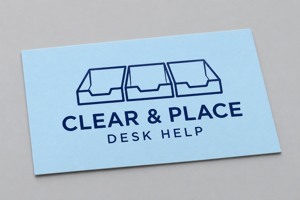
Ordinary paper for a dry desk
These ordinary printed cards for a desk-help contact route list 3.5 × 2 inches, default 14pt glossy stock, square corners and a current minimum quantity of 50. They are an optional visual reminder, not a records log, secure storage label or authorization badge.
Check existing staff instructions first. If a reusable reminder has a confirmed distribution need, compare custom business cards and prepare approved public wording with DecentCustom.
Sources and product reviewed November 15, 2026. Clear & Place and its decisions are fictional illustrations. This organizer’s method does not determine legal retention periods or verify an actual workplace’s permissions, security, productivity or business results.