Keep the butcher’s appropriate meat packaging and its original labels intact. An outer carry bag is a separate proposal: check what the customer must carry, whether the complete packs can be accommodated and whether the shop can support the intended use. A foil lining or a published bag size does not answer those questions by itself.
Start with the actual shop’s packaging and service
Review the order as it leaves the shop, rather than loose cuts or a guessed number of pounds. The meat packs, their closures, labels and accompanying information already have a job. Adding a logo bag is not a reason to open a pack, remove a label or substitute a different food package.
Services also differ. The Meat Hook’s groceries page describes pickup, delivery routes and a monthly butcher box with recipes. That is one operator’s service information, not a specification for its meat packaging or evidence that a promotional tote can replace it.
For a real proposal, have the person responsible for the actual packaging and handling arrangement identify what must remain together and which uses need separate review. Collection at the counter and parcel shipping are different jobs. Do not turn a carrying accessory into a shipping proposal simply by closing its zipper.
Describe packed units before selecting the outer bag
Copperhedge Butchers and the people and review results below are fictional. This worked example is a buying-decision exercise, not a real meat order or a test of the pictured product.
Mina’s proposed collection bundle
- Pack A: one complete shop-prepared steak pack containing two steaks.
- Pack B: a second complete shop-prepared steak pack containing two steaks.
- Pack C: one complete shop-prepared roast pack.
- Information: the original product labels stay on the packs; the order record and supplied instructions remain available for the handoff.
There are three packed units: two steak packs plus one roast pack. The four steaks are not four separate carrying units. Piece counts do not establish the total weight, outside dimensions, acceptable orientation or carrying suitability of the bundle.
Measure the actual completed packs and record their permissible arrangement through the shop’s own review. Include bulky seams, closures and anything that must remain attached. A rectangular body measurement on a bag page does not establish its usable opening, clearance below the zipper or access around an irregular pack.
A bag can admit the packs and still fail the proposed job
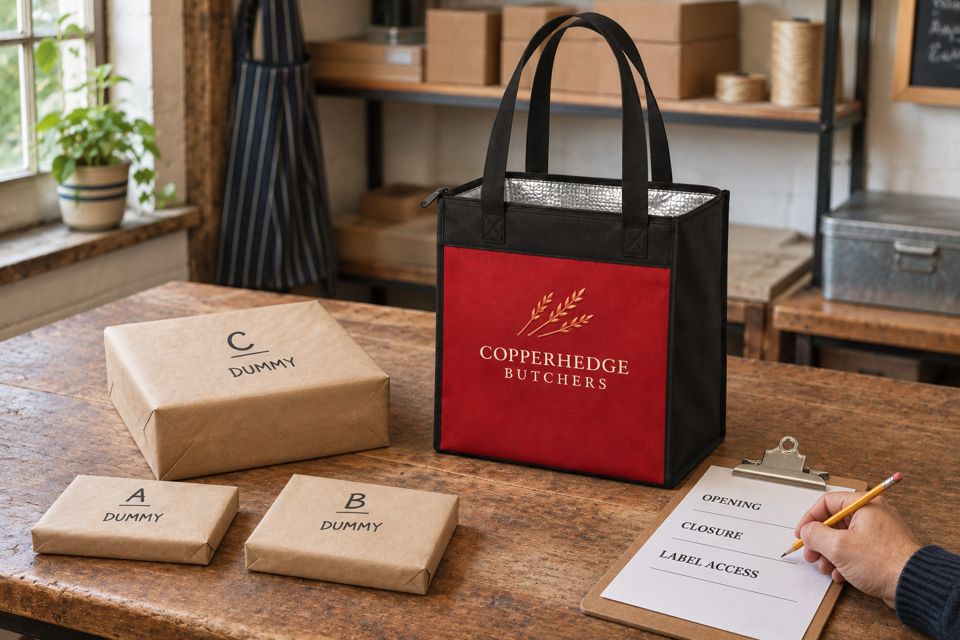
Use clearly marked dry, non-food dummies to explore layout before considering any real use. Such a layout exercise can reveal an obvious access or closure problem. It cannot establish meat safety, leakage resistance, carrying strength or temperature performance.
A completed fictional layout-review note
Reviewer: Mina, counter coordinator. Proposal: one optional outer bag for the three intact packed units above.
Entry: the three dummy units can be placed through the sample opening individually in the proposed arrangement. This observation concerns the dummies only.
Closure: the top of dummy C obstructs the zipper path. The bag cannot be closed as proposed without changing the arrangement. No one forces the zipper or removes part of a dummy to create a passing result.
Access: reaching the lower dummy would require moving the upper one. Before approving an alternative layout, the counter team would need to check how each actual pack can be removed without opening it or losing its attached information.
Decision: do not approve this layout. Retain the existing appropriate carrying arrangement while Owen, the buyer, reviews a different accessory proposal. The entry observation does not cancel the closure failure.
This is a useful stop point: “it goes in” and “it works for the intended carrying job” are different findings. Do not solve a bag-size problem by reducing an agreed meat order, stripping its packaging or treating an open-top arrangement as an approved substitute.
What the listed tote tells you—and what still needs checking
Compare lunch bags and coolers after recording the actual carrying requirements. A different catalog photograph is not proof of suitability either. If the existing appropriate system already meets the job, an extra branded bag may add no necessary function.
A supplier inquiry that keeps the unknowns visible
Owen’s draft inquiry
Hello,
We are evaluating an optional outer carrying bag for butcher-shop collection orders. Our actual meat packs, closures, labels and supplied instructions must remain intact. This is not a request to replace food packaging or a parcel-shipping system.
Please confirm the usable opening, space below the closed zipper and the relevant measurement method for SKU decentcustom-to-000814. We will supply the actual completed-pack measurements and proposed arrangement after our shop review; the fictional dummy sizes in our planning exercise are not product specifications.
Please provide the applicable use, care and handling information and identify any supporting evidence relevant to the intended carrying job. We have not established a required load, temperature duration or leakage performance. Please distinguish documented information from general product descriptions.
We have seen a minimum of 50. We have not approved that quantity, a color, artwork or a purchase. Once the job and quantity are settled, please identify the exact configuration, complete price including applicable shipping and tax, and the proposed production and delivery dates for review.
Thank you,
Owen, Copperhedge purchasing
Keep the carrying decision separate from order readiness
Mina keeps the failed-layout note with the proposal. Owen owns the unresolved supplier questions. The counter team continues the existing appropriate arrangement; it does not tell a customer that a new bag has been approved. If the accessory later changes, record the version reviewed and what the approval actually covers.
Use the separate custom cut and pickup instructions to keep order details and collection status clear. A ready message concerns the agreed order. It does not certify a new carrying accessory or authorize a change to the food packaging.
Settle the carrying job before commissioning artwork
Bring the completed-pack description, unresolved questions, actual quantity and approved intended use to DecentCustom when a printed accessory is justified. Keep a suitable existing option in service while the new proposal remains unresolved. Artwork is a later step than deciding what the bag must actually do.