Before printing butcher-counter copy, check each customer-facing statement against the current item and service record. Keep internal supplier codes, public product names, verified attributes, price units and availability separate. A finished design is still a draft until the responsible shop team has checked its wording.
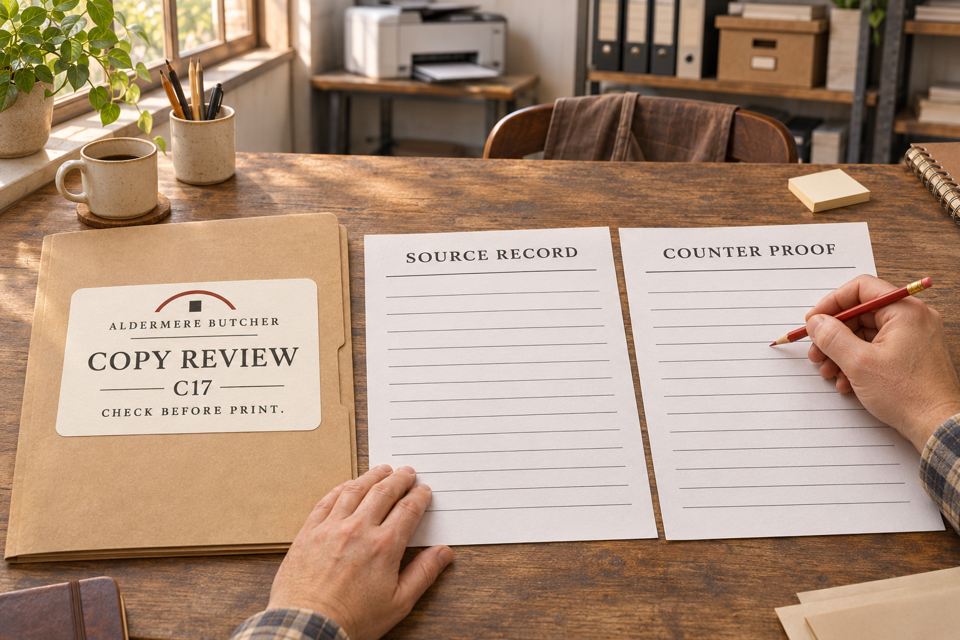
An internal reference is not automatically a customer description
A supplier name, invoice heading or stock code can help staff find the right record. It should not silently become a cut name, origin claim or product characteristic in public copy. Ask what each field actually identifies before the designer turns it into a headline.
For each proposed statement, locate its current source and name the person who can resolve a discrepancy. A photograph alone may not establish the exact cut or whether a stated attribute applies to the item being offered. When identity is unresolved, hold the product-specific wording rather than choose a plausible description.
Also separate a unit price from an unexplained number and a current offer from an ongoing availability promise. The team needs the actual approved amount and unit together. It cannot infer “per pound,” “per pack” or “each” from the space left on a sign.
A realistic-looking proof that should be returned for correction
Aldermere Butcher, its staff and all records and wording in this example are fictional. The draft below deliberately contains unconfirmed statements. It is not a real product offer, price or suggested meat label.
Draft C17: not approved for printing
Proposed headline: Meadow Ribeye
Proposed description: Boneless
Proposed price line: $18
Proposed availability: Every day
Source record available to the reviewer: internal item R17 is described as beef ribeye. “Meadow” appears in the supplier heading. The file does not establish that “Meadow Ribeye” is the approved public name. It does not confirm the proposed bone description, the price amount and unit, or everyday availability.
Ruth’s review decision: hold this product-specific proof. Do not publish it, print it or move its unconfirmed wording onto another surface. Ask the person responsible for the current item record to resolve each missing field.
Removing one questionable word would not resolve the entire proof. Even a corrected name could sit beside an ambiguous price or an unsupported availability statement. Review the complete combination of headline, description, price and timing.
Keep the existing appropriate information arrangement while the new copy is unresolved. If existing product information is itself in doubt, route that discrepancy to the responsible shop team; do not treat “leave the old sign up” as an automatic answer.
Give the copy owner questions that can actually be answered
Ruth’s complete correction brief to Leon
Hi Leon,
Please hold counter proof C17. We have not approved its customer-facing product information.
For internal item R17, please confirm the exact public product name from the current item record. “Meadow” appears in the supplier heading, so please establish whether it belongs in the public name rather than carrying it into the headline by assumption.
Please confirm whether the proposed “boneless” description applies to the actual item being offered. If the record does not resolve this, keep that field pending rather than infer it from a photograph or an older batch.
Please obtain the approved current price amount and the unit together. The draft’s “$18” has not been approved and has no unit. Also confirm what availability wording, if any, can be supported for this offer; “every day” is not established by the available record.
Return the corrected complete copy with the record it was checked against and the responsible reviewer’s decision. I will compare the full revised proof, including any line wrapping or artwork changes, before releasing it for the intended counter position.
Until that review is complete, do not print C17 or reuse its wording in the website or order messages. This request concerns promotional counter copy; the actual meat packaging and its required information remain under the shop’s existing process.
Thank you,
Ruth, Aldermere counter-copy coordinator
This is a draft internal message, not an inquiry actually sent to a supplier or a claim that a named business uses inaccurate descriptions. The useful output is a set of resolved fields and a review decision, not simply a new-looking layout.
Print stable service information separately from changing offers
Not every useful counter message needs a price or a particular cut. While product-specific copy is being checked, the shop may have a separate reason to explain how customers can ask about current items. The following fictional wording serves that narrower purpose:
Example service prompt, separate from C17
ALDERMERE BUTCHER
Ask the counter team about current cuts, prices and packing options.
Please wait for confirmation of your agreed order details and collection arrangement.
This prompt does not resolve the missing information in C17 and does not claim every option is available. Decide which information changes frequently before committing it to a print run. A current ordinary printout or an existing updateable sign may suit a changing offer better than a stack of fixed labels.
Food-service timing is also different from print procurement. The Meat Hook’s groceries page describes next-day pickup and a monthly butcher box. Those service intervals do not establish how often this shop should replenish printed supplies or how quickly a custom print order will arrive.
Do not carry an old approval into a changed item
Leon resolves the item questions; Ruth owns the counter-copy release in this fictional workflow. If a later batch, item description, price unit or offer period changes, they review the affected copy again. An earlier approval concerns the version and record reviewed, not every future use of the same design.
Keep the released proof and its source reference distinguishable from the held draft. Record where the current version is used so the team can replace a superseded counter notice and check the corresponding website or message copy. Avoid treating a corrected print file as proof that every live surface has already been updated.
Individual cut requests and collection status belong in the order record. Use the separate custom cut and pickup instructions for that handoff. A general counter prompt does not confirm a particular customer’s order.
Use a dry-office label only when it helps identify the file
Compare paper label formats if the office needs a repeatable identifier. A handwritten folder title or ordinary paper index can already provide that function. This guide addresses copy review; it does not determine the food information required for an actual product or replace the shop’s applicable review process.
Release the words before commissioning their final format
Take the approved copy, actual dry-office use, finished dimensions and confirmed quantity to DecentCustom when a printed identifier adds value. Keep the held proof clearly marked until its questions are resolved. Accurate source-to-copy checking comes before ordering more versions of the same uncertainty.