Give learners a clear next step by naming the specific status that has actually been confirmed. A received inquiry, a reserved class place, a finished object and a course-completion record answer different questions. Calling all four a “confirmation” can leave the learner unsure whether to attend, collect something or wait.
This is a communications decision for adult course coordinators and front-desk teams. Before class, confirm which materials are supplied or borrowed. Afterward, use the appropriate record to decide which notice can be sent.
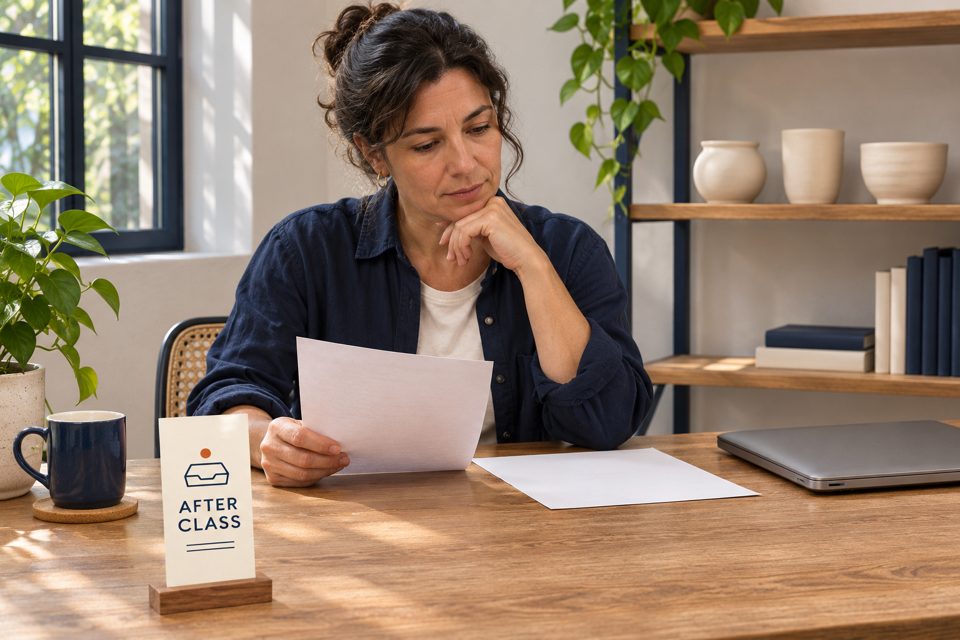
AI illustration of a studio coordinator reviewing separate records. The people, pottery and After Class artwork are illustrative.
Use a status name that answers the learner’s question
Start with the question the message needs to resolve, then identify the record that supports the answer. The following distinctions are an editorial framework; the provider’s actual booking and teaching policies still govern.
Question
Record to check
What the notice can say
Did my inquiry reach you?
Received inquiry or message
The request was received; say whether another response is needed.
Do I have a place in this class?
Confirmed booking for the identified session
The place is confirmed, with the applicable preparation and attendance details.
Can I collect my finished work?
Actual readiness and current collection arrangements
The identified work is ready, where to collect it and the applicable collection window.
Can I receive a completion document?
The provider’s completion requirements and authorized record
Explain the applicable request or issue process and what remains to be checked.
Potterings’ FAQ illustrates the first distinction: it describes an immediate acknowledgment that an email was received, followed by registration confirmation. The acknowledgment alone should not be presented as the later confirmation. Keep that distinction visible even when both messages come from the same inbox.
If your booking system already makes these stages clear, retain its notices. Add an explanation only where the actual wording or handoff leaves a question unanswered.
A class ending does not tell you that an object is ready
In a making class, the learner’s attendance and the object’s readiness can follow different timelines. Potterings describes finished pottery being available five to six weeks after class and separately publishes a holding period. Those are that studio’s arrangements, not a general pottery-school deadline.
Ballard Clay’s series-class FAQ gives different examples. Its wheel-series outline says finished work is collected three to five days after the class ends, with an email when ready. Its hand-building outline describes collection within a week. The useful comparison is that even one studio distinguishes course formats; another provider’s estimate should not be copied into your notice.
Before sending a collection message, have the responsible staff member confirm the work’s actual status and the current pickup arrangements. Include the course or collection reference your system uses, the location, available collection times and the applicable hold-by date if there is one. Explain how to ask about an alternative arrangement through the provider’s established route.
A general “thanks for coming” message can be sent for a different purpose. It should not announce readiness unless that has also been checked. Likewise, a learner collecting an object has not thereby satisfied an unrelated certificate requirement.
Follow the provider’s completion-document process
Seattle Central Continuing Education’s certificate page describes a post-class request. The learner supplies the class details; staff confirm attendance and email the certificate. The page specifies an attendance requirement and asks learners to allow time after completion for the certificate to become available.
This is a separate process from buying a class place or receiving a workshop object. Use the issuing provider’s exact document name and instructions. A front-desk employee can explain a request route without announcing that a pending check has passed.
Keep participation, completion and any separate professional credential distinct in the wording. Do not describe an ordinary printed information card, a booking receipt or a souvenir as an official course-completion document. Ask the program owner to approve the language if the course has its own assessment or issuing process.
Worked example: one learner, two pending questions
Fictional planning example: a community studio offers a making workshop. Its record shows that Jordan attended. The finished object is still awaiting the studio’s readiness check. The studio also offers an optional attendance document through a separate request process. These invented conditions demonstrate the communication method; they are not the rules of any provider cited above.
A message such as “Your course is complete and everything is ready” would combine facts that have not all been established. A clearer reply is:
“Thank you for attending the workshop. Your finished work has not yet been confirmed ready for collection. Our studio team will send a separate collection notice with the pickup details once that check is complete. If you would like an attendance document, please use the request instructions in your course account. That request is reviewed separately from collection.”
Before using a version of this message, replace the example routes with the real ones and confirm who owns each follow-up. If work is ready, replace the pending sentence with the verified collection instructions. If the provider does not issue an attendance document, remove that offer. Keep the attendance record internal except for the information the learner needs.
For a brief internal release check, record: course or booking reference; status being communicated; supporting record; person who confirmed it; next action; current contact route; review date. An unknown status stays pending until the responsible person checks it. This is a suggested communications record, not a replacement for the institution’s student or inventory system.
Print stable routing information only when it helps
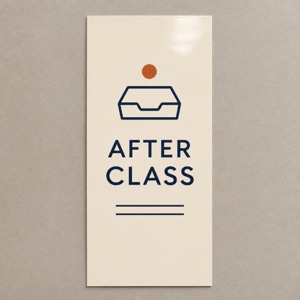
If reception repeatedly explains where to find after-class instructions, custom rack cards for general after-class instructions are one possible format. Use them for the maintained information-page address and approved general contact route. Keep personal status, changing pickup dates and completion decisions in the appropriate system.
The linked paper SKU is 3.74 × 8.27 inches, with a default 14pt glossy option and a starting quantity of 50. A holder is separate. The illustration is an AI design concept for an ordinary information card; it is not a certificate, a collection authorization or a finished-order photograph.
Review rack card formats and options and check an actual-size proof before preparing authorized artwork with DecentCustom. If the existing course account or email already supplies clear instructions, continue using it without adding a printed piece.
Provider pages and the linked SKU were reviewed November 13, 2026. The framework, internal check and worked reply are editorial suggestions. They do not establish another school’s policies or demonstrate improved attendance, qualification, search visibility or sales.