A first campus career fair can help you choose what to learn next. Check which booths welcome first-year students, bring one example of work you’ve done, and ask a question whose answer you can act on.
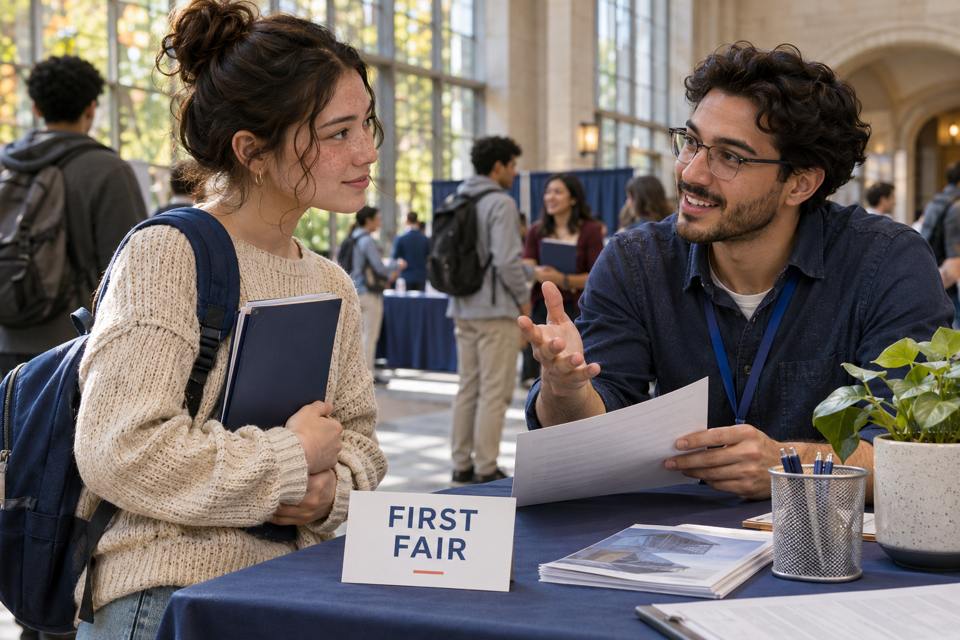
Illustrated campus fair conversation with fictional First Fair artwork.
Is a campus career fair worth attending in your first year?
It can be if you can enter the fair and find at least one employer or career adviser willing to talk with students who are still exploring. Give yourself a reason to go. For example, you might want to find out what skills a local operations team expects students to bring to a later internship.
Check the campus event listing first, then the organization’s listing and any specific role. The UW–Madison fair guide, for example, explains its own separate event registration rules and says employers open to meeting first-year students are marked at the fair. Check what your fair publishes and ask the career center what an ambiguous booth label means.
A company may be taking internship applications from later years and still run an information session open to you. If the booth is reserved for eligible applicants, put that employer on your list for another event and visit a table open to first-years now.
What can you say when you have no internships on your résumé?
In a University of Michigan engineering fair discussion, a student asks what freshmen can put on a résumé. An organizer points to transferable skills from work or leadership and suggests preparing an introduction. Start with one small example you can explain yourself: a shift at work, a class project, a club responsibility or time spent volunteering.
A self-described recruiter in an Illinois campus forum thread encourages first-year students to get the practice and advises pausing after the introduction. Try saying your name, major or area of interest and why you came to that table. Give the recruiter a turn before explaining the example.
A fictional introduction you can adapt
“Hi, I’m Sam, a first-year student interested in operations. I saw that your team coordinates inventory across several stores. At my campus café job, I leave the next shift a list of what we ran out of. What would be a useful skill or project for a student interested in that side of the work?”
The café detail works because Sam can explain what was on the list and who used it. If asked, Sam can describe one adjustment that made the handoff easier. The recruiter gets a specific experience to respond to, and Sam gets an answer to use this semester.
Ask a question you can turn into something concrete
“What would you study next if you were in my first year?” invites a broad answer. Put one detail into the question so you can use the answer. For example, ask what a new intern does with an inventory spreadsheet. If the visitor behind you is waiting, finish by asking where to find the team’s student information when you get home.
Say the recruiter describes reconciling delivery quantities against an order. Step away from the line and write down: “Inventory team. Compare an order with what actually arrived and explain any mismatch. Practice on a made-up order in a spreadsheet and bring the example to a career adviser.” Use fictional or public data for practice. Save the employer’s public student page if they showed you one.
One prompt for a campus career center to share
Hand a first-time visitor a question they can try and a place to write the answer. For a campus organizer, a card can also point to the live employer list through a readable address. Keep current room numbers, eligibility and booth assignments in the event listing. Students can use the same prompts in their phone notes.
A take-home question card
These custom postcards for a campus fair prompt list a 6 × 4-inch format and one- or two-sided full-color printing. The listed order increment is 50. Print a stable prompt as artwork and check how the event page opens on a student’s phone.
Check the fair’s instructions. Have a short introduction and one example ready for an exploratory conversation. If an employer requests a résumé, use the format and submission route it gives.
Should I stand in line for a company that hires only juniors?
Check whether the table is also open to informational questions. When it’s marked for eligible applicants, ask the career center about another way to learn about the employer.
What should I write down if nobody is hiring first-years?
Record an employer, one concrete skill or task you learned about and how to explore it. If you couldn’t speak to anyone, start with an employer’s published student resources or ask a campus adviser.
Forum posts reflect individual experiences. Event eligibility and employer criteria vary. The conversation, student and artwork are fictional.